
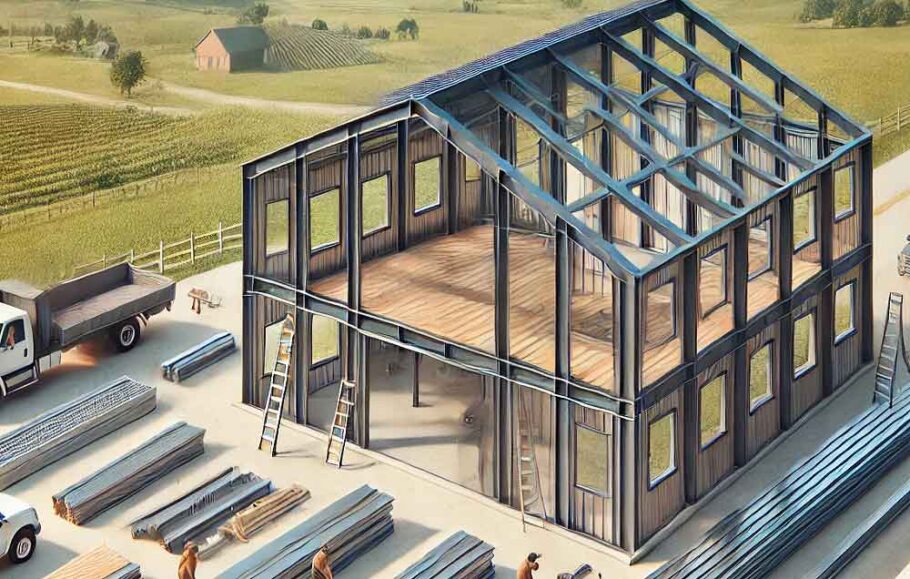
The barndominium craze has swept across America like a prairie wind. These steel-framed hybrids offer open floor plans, lower construction costs, and that rustic-meets-modern aesthetic that sells so well on Instagram. But out in earthquake country—from California’s Central Valley to the Cascadia subduction zone up through Washington, down into the New Madrid fault region affecting Missouri and Arkansas, and across the Wasatch Front in Utah—a quiet question keeps coming up: are these things actually safe when the ground starts moving?
The short answer is complicated. The long answer might save someone’s life.
What a Barndominium Actually Is
Most people picture a barndominium and think “metal building with drywall.” That’s not wrong, but it misses critical engineering details. A typical barndo uses a post-frame construction method. Large wooden posts—or more commonly now, steel I-beams or red iron framing—get set into concrete piers or embedded directly into a slab foundation. The roof and walls attach to this frame, and the whole thing gets skinned with metal panels.
This is fundamentally different from conventional stick-frame housing. Standard wood-frame houses rely on shear walls—plywood or OSB sheathing nailed to studs in a specific pattern that creates lateral resistance. The entire system works together to distribute seismic forces. A barndominium relies primarily on its rigid steel frame and the diaphragm action of its metal skin.
The Steel Frame Advantage
Here’s where things get interesting. Steel has something that wood doesn’t: ductility. When a wood frame gets hit with strong lateral forces, it can crack, split, and fail abruptly. Steel, on the other hand, bends. It yields. It absorbs energy by deforming rather than shattering. In seismic design, that ductility is pure gold.
A properly engineered steel barndominium frame can handle significant ground motion. The welded connections, when done right, transfer loads efficiently from the roof down to the foundation. The metal panels themselves, screwed to the girts and purlins, create a continuous load path. In theory, a steel barndo should outperform a stick-frame house of comparable weight.
But theory and practice don’t always shake hands.
Where the Vulnerabilities Live
The truth nobody wants to talk about is that most barndominiums are not engineered for seismic loads at all. They’re designed for gravity. Snow loads, wind loads, dead loads—sure. But lateral earth movement? That gets treated as an afterthought or ignored completely.
The problem starts with the foundation. Many barndos sit on what’s called a floating slab—a concrete pad with thickened edges but no deep foundation elements. That slab might have some rebar, might have some mesh, but it’s not tied into the earth. In a moderate quake, the ground can literally move out from under that slab. The building stays intact, but the slab cracks, shifts, or settles unevenly. Now the frame is racked, doors won’t close, and structural integrity becomes a question mark.
Then there’s the post-to-foundation connection. In cheap barndo kits, those vertical steel columns might just sit on top of the slab with anchor bolts that are undersized or improperly embedded. No moment connection. No base plate designed for uplift and shear simultaneously. When horizontal forces hit, the column base acts like a fulcrum. The bolts either shear off or pull out of the concrete.
The Mezzanine Problem
Barndominiums love mezzanines. That second-story loft space overlooking the main living area is practically a design signature. But mezzanines create a concentrated mass up high, and earthquakes hate mass up high. The seismic force on a building increases with weight and height. A steel-framed mezzanine that isn’t properly braced and tied into the primary structure becomes a giant pendulum. It can sway independently, racking the main frame and potentially collapsing downward during strong shaking.
Open floor plans make this worse. Conventional houses have interior walls that, whether intended to or not, provide some lateral bracing. A barndo’s wide-open interior has no such accidental benefits. Every bit of seismic resistance has to come from the perimeter frame and whatever bracing the designer explicitly included.
The Veneer Trap
Here’s something that catches people off guard. Many barndominiums incorporate stone or brick veneer on the exterior, usually around the entryway or as accent columns. That veneer is heavy. Really heavy. And it’s typically attached to the steel frame with metal ties or adhered directly to the metal panel substrate. When the building flexes during an earthquake—and it will flex—the masonry veneer doesn’t flex with it. It cracks, spalls, and can peel away from the building in dangerous sheets.
The same applies to interior finishes. Large format tile, stone countertops, glass shower enclosures—all heavy, all brittle, all potential projectiles or collapse hazards when the structure starts moving.
Regional Differences Matter
Seismic risk isn’t uniform, and neither are barndominium building practices. In parts of the Midwest where tornadoes are the primary concern, barndos actually perform reasonably well because wind design overlaps somewhat with seismic design. Both require strong connections and continuous load paths. But a building designed for 120 mile per hour winds isn’t automatically safe for a magnitude 7.0 quake. Wind loads are lateral but they’re also directional and relatively predictable. Seismic loads shake from every direction, reverse direction rapidly, and apply cyclic loading that can fatigue connections over seconds rather than years.
In high-seismic zones like coastal California or the Pacific Northwest, building codes require specific seismic design categories. A barndominium in these areas needs a geotechnical report, a structural engineer’s stamp, and details that comply with ASCE 7 seismic provisions. The problem is that many barndo kits come from manufacturers in low-seismic regions like Texas or the Southeast, where earthquakes barely register as a concern. Those kits don’t include the necessary bracing, anchorage, or detailing for high-seismic applications. Builders sometimes use them anyway, either out of ignorance or because the client wants to save money.
What Proper Seismic Design Actually Looks Like
A seismically sound barndominium starts with the ground itself. The foundation needs to be engineered for the specific soil conditions at the site. Soft soils amplify shaking. Liquefaction-prone soils require deep foundations. A simple slab on grade won’t cut it in many areas.
From there, the column-to-foundation connection needs to develop the full strength of the column. That means base plates with stiffeners, properly torqued anchor rods embedded deep into a continuous footing, and often a moment-resisting connection rather than a simple pinned connection. Cross-bracing or shear walls need to be distributed throughout the building in both directions. The metal panel diaphragm needs to be attached with the right screw pattern and panel thickness to transfer loads effectively.
Mezzanines need their own seismic force-resisting systems and must be positively connected to the main frame with allowance for differential movement. Heavy finishes need to be detailed with flexible connections or replaced with lighter alternatives. Even the non-structural elements—lighting fixtures, HVAC equipment, shelving—need seismic restraints.
Retrofitting Existing Barndos
For anyone already living in a barndominium in earthquake country, retrofit options exist but they’re not cheap or easy. Adding shear walls to an open floor plan means sacrificing some of that openness. Installing new foundation anchorage might require cutting into the slab or underpinning from below. Adding cross-bracing means running visible steel cables or rods through living spaces.
The most cost-effective retrofit for most existing barndos focuses on the weak links: upgrading column base connections, adding hold-downs at critical points, and bracing the roof diaphragm. A structural engineer needs to evaluate the specific building, but the general principle is to identify the most vulnerable failure modes and address those first. Anchoring the building to its foundation usually tops that list.
The Code Reality
Current building codes treat barndominiums as either residential or agricultural structures depending on occupancy, and the requirements vary wildly. The International Residential Code has specific provisions for seismic design, but those provisions assume conventional light-frame wood construction. Post-frame and steel buildings fall into a gray area. Many jurisdictions require engineered design regardless of code classification, but enforcement varies.
The honest truth is that many barndominiums get built without permits in rural areas, and seismic safety never enters the conversation. That’s a gamble that might pay off for decades. But when the big one hits, the difference between a properly engineered building and a cheap kit becomes a matter of survival.
The Bottom Line
Barndominiums can be seismically safe, but not automatically. The steel frame gives them inherent advantages in ductility and strength, but those advantages disappear without proper foundation design, connection detailing, and bracing. A barndo built from a cheap online kit and thrown up by a contractor who usually builds pole barns is not safe in earthquake country. A barndo designed by a structural engineer, permitted through a jurisdiction that enforces seismic codes, and built with attention to load paths and anchorage can meet or exceed the performance of conventional construction.
The truth cuts both ways. Barndominiums aren’t inherently dangerous in earthquakes, but they aren’t inherently safe either. They’re just buildings. And like any building, what matters isn’t the label or the aesthetic or the square footage. What matters is the engineering that went into it, the quality of construction, and whether someone designed it to stand up when the world starts shaking.