
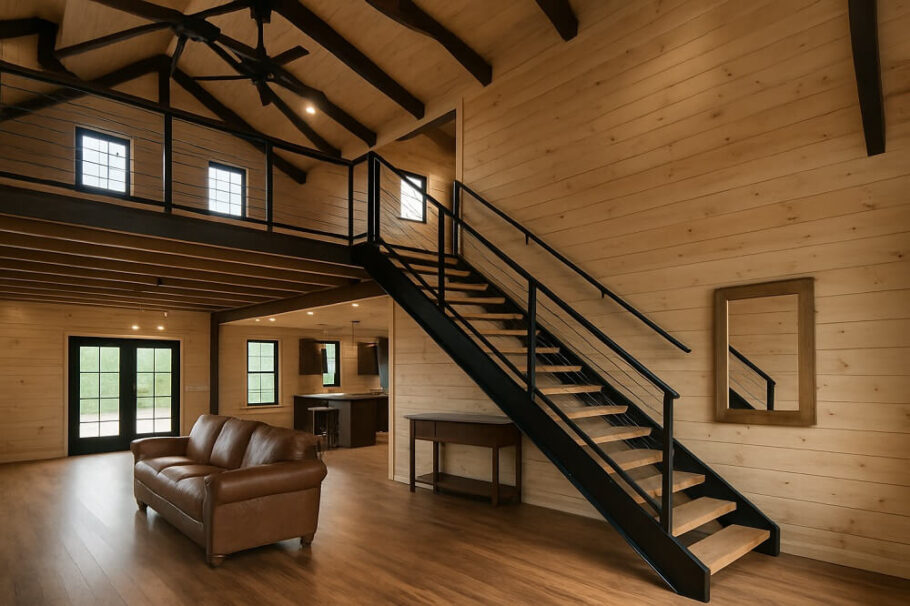
The barndominium craze isn’t slowing down. These steel or wood-framed structures offer open layouts, lower construction costs, and that rustic-meets-modern vibe so many homeowners want. But here is a question that comes up more and more: what about going vertical? Adding a second floor to an existing barndominium sounds like a smart way to double living space without expanding the building’s footprint. The reality, however, is that most barndominiums weren’t built with a second story in mind.
So can it be done? Yes. But the path to a two-story barndo involves serious structural reinforcement. Ignoring that reality leads to sagging floors, cracked drywall, doors that won’t close, and in worst‑case scenarios, catastrophic failure.
Understanding What You Are Working With
Most barndominiums use post‑frame construction. Thick wooden posts set in concrete or on pier foundations carry the weight of the roof and walls. The spacing between these posts—typically eight to twelve feet—works beautifully for single‑story living. The roof trusses are designed for snow loads and wind, not for supporting an entire second floor of bedrooms, bathrooms, and furniture.
The problem becomes clear when looking at the load path. A second floor adds what structural engineers call live loads (people moving around, furniture, appliances) and dead loads (the floor system itself, subflooring, finish materials). A typical residential second floor must support at least 40 pounds per square foot of live load plus another 10 to 15 pounds of dead load. Multiply that by the building’s footprint, and suddenly a 40×60 barndominium needs to handle over 120,000 pounds of additional weight. Those original twelve‑foot post spans were never meant for that.
The Foundation Conversation Nobody Wants to Have
Before thinking about floor joists or steel beams, look down. The foundation is where this project lives or dies. Post‑frame barndominiums often sit on shallow foundations—concrete pads under each post with minimal footings. Adding a second floor might require underpinning every single post with deeper footings or even pouring a continuous perimeter foundation.
Concrete slab foundations deserve special attention. Many barndos use a monolithic slab with thickened edges. That works fine for one story. For two stories, the slab may need to be entirely replaced or supplemented with grade beams that transfer loads to deeper soil layers. A geotechnical engineer should evaluate the soil bearing capacity before any plans get drawn. Sandy or clay soils that worked for a single story can fail dramatically under double the load.
Reinforcing the Vertical Posts
The wooden posts themselves present another challenge. Standard 6×6 posts might handle the compressive load of a second floor if spacing is tight enough. But few barndominiums were built with that kind of spacing. The more common scenario involves posts that are simply too small and too far apart.
Sistering new posts alongside existing ones is a practical solution. Adding a second 6×6 or upgrading to 8×8 posts bolted through the existing structure can effectively double the load capacity. The connection details matter enormously. Through‑bolts with large washers, properly torqued and spaced every sixteen to twenty‑four inches, create a composite post that behaves like a single, much stronger member.
Steel reinforcement offers another path. Flitch plates—steel plates sandwiched between two wooden posts—add tremendous strength without increasing the post footprint. A half‑inch steel plate bolted between two 6×6 posts creates a column stronger than most solid 8×8 posts. The challenge lies in cutting the existing structure open to insert these plates, which usually means temporary shoring and careful sequencing.
The Floor System Demands Respect
Adding a second floor requires installing a new floor system at the height where the second story begins. This cannot simply rest on the existing wall girts. Those horizontal boards are meant for siding attachment, not for carrying floor loads. The new floor needs its own structural support that transfers directly down to the reinforced posts or foundation.
Steel I‑beams running the length of the building create a solid platform. By setting these beams on top of the reinforced posts, loads travel straight down without putting stress on the original wall framing. From there, wood joists or steel bar joists span between the I‑beams. This approach costs more but eliminates guesswork.
For those wanting to stick with wood, glulam beams or LVL (laminated veneer lumber) headers can span between posts. A triple 2×12 LVL beam spanning ten feet can support a surprising amount of weight. The catch is that the posts underneath must be properly sized and the connection between beam and post must be engineered. A simple notch in the post with a few nails will not cut it. Simpson Strong‑Tie makes heavy‑duty connectors specifically for these applications, but proper bolting with threaded rod is even better.
Lateral Forces Become a Real Issue
Single‑story barndominiums handle wind and seismic loads through the roof diaphragm and the shear resistance of the siding. Add a second floor, and lateral forces change dramatically. That second floor acts like a giant lever, pushing the walls sideways during high winds or an earthquake.
Shear walls become necessary. A shear wall is simply a section of wall sheathed with plywood or OSB and nailed off at tight intervals—often two to four inches on center along the edges. These walls resist racking forces that would otherwise collapse the structure. Existing barndominiums rarely have adequate shear walls because the post‑frame system with metal siding provided just enough resistance for one story.
Adding interior shear walls around stairwells, bathrooms, or closets solves this problem without changing the exterior appearance. Each shear wall needs a continuous load path from the second floor down to the foundation, which means anchor bolts or straps tying the wall bottom plate to the slab or foundation.
The Roof Truss Question
Here is where many projects hit a hard stop. The existing roof trusses almost certainly cannot remain in place. They were designed to sit on the outer walls and carry only the roof. Adding a second floor means either removing the trusses entirely or raising them.
Raising trusses is possible but painful. Each truss must be lifted, new bearing points created at the higher elevation, and the roof deck re‑attached. The cost often exceeds simply removing the old trusses and building new scissors trusses or a stick‑framed roof that accommodates the second floor ceiling height.
Some barndominiums use attic trusses designed for storage. Those have a larger bottom chord capable of handling maybe ten pounds per square foot—fine for Christmas decorations, not for a bedroom. Do not fall into the trap of thinking storage trusses can convert to living space. The difference between ten psf and forty psf is enormous.
Stair Placement Changes Everything
A two‑story barndominium needs stairs, and stairs eat up floor space. More importantly, stairs create a concentrated load path. The posts supporting the stair landing and the stairwell opening require extra reinforcement.
Cutting a stair opening through the new second floor requires doubling or tripling the floor joists around the opening. The header joists at each end of the opening carry the weight of the cut joists. In a wood floor system, that means multiple jack joists and properly sized hangers. In a steel system, it means additional beam members.
The stair location should sit directly above a reinforced post or a cluster of posts whenever possible. Running stairs parallel to the main I‑beams makes this easier. Running stairs perpendicular often means adding new support columns in the middle of the first floor space, which defeats the open concept many barndominium owners love.
Permits and Engineering Are Not Optional
Every jurisdiction requires permits for adding a second floor. The permit process forces structural calculations, and those calculations will reveal any weaknesses. Trying to bypass permits creates liability nightmares for resale and insurance.
A structural engineer needs to produce stamped drawings. This costs money—often two to four thousand dollars for an existing building evaluation and reinforcement design. That money buys peace of mind. The engineer will specify exactly what size beams, what post reinforcements, and what foundation modifications are required. No guessing, no hoping, no watching the walls slowly crack over five years.
Engineers also catch problems that non‑professionals miss. For example, the point load from a new steel beam may land directly between two existing posts. That requires a new post or a transfer beam. An engineer calculates whether the existing slab can handle that point load or if a new spread footing must be poured.
Practical Reinforcement Tips for DIY Thinkers
Even with an engineer’s blessing, much of the work can be done by a determined owner. But certain tasks demand professionals. Welding steel beams, pouring new footings, and lifting heavy members require skills and equipment most homeowners do not have.
For the work that is DIY‑friendly, focus on connections. Adding plywood shear panels, installing hold‑down anchors, and bolting sistered posts are straightforward with basic tools. The key is following the engineer’s fastener schedule exactly. If the schedule calls for 10d nails at three inches on center, do not use 8d nails at six inches. These details are not suggestions.
Temporary shoring deserves serious attention. Before cutting any existing posts or removing any wall sections, support the roof with adjustable steel lally columns and heavy timbers. A roof that settles even half an inch creates problems that never fully go away. Cracked drywall, stuck windows, and misaligned doors become permanent features of the home.
When Adding a Second Floor Makes Financial Sense
The honest answer is that adding a second floor to an existing barndominium rarely makes financial sense compared to building new. The cost of structural reinforcement, new foundation work, temporary shoring, and engineering fees often exceeds the cost of constructing a new two‑story barndominium from scratch. Why fight with an existing structure when a clean start costs the same or less?
That said, there are exceptions. Barndominiums with over‑built foundations and widely spaced heavy timber posts sometimes convert smoothly. Buildings with existing 8×8 posts on six‑foot centers and deep concrete footings are rare but do exist. Also, properties where zoning or setback restrictions prevent new construction might force the issue.
For everyone else, the smarter move is often to build a separate second structure, add a dormer loft within the existing roof volume, or accept that the barndominium works best as a single‑story home. The dream of a second floor is compelling, but the structural reality is unforgiving. Proper reinforcement makes it possible. Cutting corners makes it dangerous. Choose accordingly.