
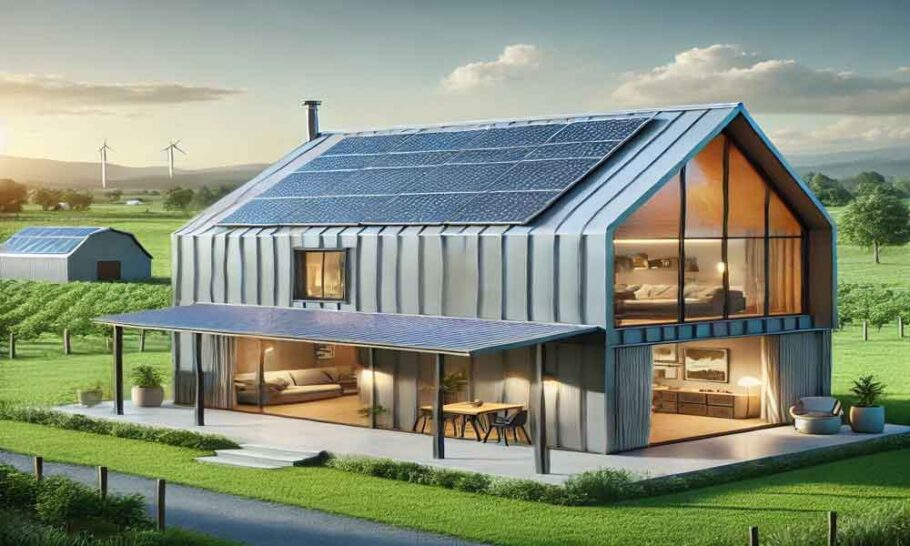
When most people picture a barndominium, they see the aesthetic: soaring ceilings, exposed beams, and the industrial charm of a steel building converted into a home. But underneath that rustic façade lies an opportunity that most builders overlook. If you are going to invest in a post-frame structure with a massive, uninterrupted roof plane and wide-open southern exposure, you have the perfect canvas for passive solar heating.
The problem is that most barndominiums are engineered like barns first and homes second. They are often built with thermal bridging issues, inadequate glazing, and a lack of thermal mass. To engineer a barndominium for passive solar, you have to stop thinking like a general contractor and start thinking like a building scientist. You need to treat the building envelope not as a shield against the environment, but as a battery that charges during the day and discharges warmth at night.
Here is how to do it right, from the slab up.
The Orientation Principle: It Starts with the Ridge
You cannot retrofit true passive solar design onto a structure that is pointed in the wrong direction. Before a single steel column is set, you must determine the solar orientation of your build site. In the northern hemisphere, the primary glazing—the windows that will let the sun in—must face true south, not magnetic south.
For a barndominium, which typically uses a gable roof, this means running your ridge line east-west. This creates a long, uninterrupted south-facing roof plane and an equally long south-facing wall. This is non-negotiable. If your land forces you to orient the building with the ridge running north-south, you lose the ability to capture low-angle winter sun effectively. You will end up with morning sun blasting the east side (overheating) and afternoon sun blasting the west side (glare and heat), with no steady heat gain during the core winter hours.
Once the ridge is oriented correctly, you need to calculate your solar window. The goal is to let the sun in during the winter when it is low on the horizon (typically between 30 and 40 degrees above the horizon depending on your latitude) and block it out during the summer when it is high overhead. This is achieved through the precise overhang of your roof eaves.
The Glazing Strategy: It’s Not Just About Big Windows
A common mistake in barndominium design is the desire for massive, floor-to-ceiling windows across the entire south face. While this looks dramatic, it creates a greenhouse effect that is difficult to control. Passive solar engineering relies on the ratio of glazing to thermal mass.
I recommend targeting a south-facing glazing area that equals roughly 7% to 12% of the total floor area. If you go above that, you risk overheating on sunny winter afternoons unless you have an enormous amount of thermal mass to soak up the excess heat.
But the type of windows matters as much as the quantity. In a standard barn conversion, builders often use cheap sliding windows or single-pane glass. For passive solar, you need high-solar-gain glazing. Look for windows with a high Solar Heat Gain Coefficient (SHGC), ideally above 0.6, specifically for the south face. You want the short-wave infrared radiation to pass through easily and convert to heat once it hits the interior mass.
Do not put high-SHGC glass on the east, west, or north faces. Those should be low-SHGC, high-R-value windows. The north face, in particular, is a thermal drain. Minimize windows on the north wall entirely. Treat the east and west with respect; west-facing glass is the enemy of passive cooling. If you want those sunset views, use high-performance tinted glass or consider adding exterior operable shading, like roll-down screens, which are far more effective than interior blinds.
Thermal Mass: The Slab is Your Battery
If the windows are the collector, the floor is the battery. In a traditional wood-framed barndominium with a raised floor system, you lose the ability to store thermal mass effectively. To engineer for passive solar, you almost certainly need a monolithic slab-on-grade foundation.
But not just any slab. You need a thermally massive slab with a minimum thickness of 4 inches, though 5 to 6 inches is better. The concrete needs to be exposed to the interior space. You cannot cover it with thick carpet or floating wood floors that act as insulators. Polished concrete, stained concrete, or thin porcelain tile set directly into thinset (which bonds thermally to the concrete) are the ideal finishes. These allow the slab to absorb the direct sunlight hitting it during the day, storing that heat, and then radiating it back into the space as the air temperature drops at night.
Here is where the engineering gets specific: you must isolate that thermal mass from the ground. If you pour a slab directly on grade without rigid insulation underneath, your thermal battery will simply conduct heat into the cold earth below. You need to install a minimum of 2 inches of closed-cell extruded polystyrene (XPS) or polyisocyanurate foam board under the entire slab. Additionally, you need vertical insulation—a “frost wall” or “thermal break”—extending vertically down the outside edge of the slab or horizontally outwards (wing insulation) to prevent the edge of the slab from wicking heat out to the perimeter.
The Envelope: Thermal Bridging and the Post-Frame Challenge
This is the hardest part of engineering a barndominium for passive solar. Traditional post-frame construction uses wood or steel posts embedded in the ground or set on piers, with girts (horizontal supports) running around the exterior. This creates a thermal bridge nightmare. The steel or wood framing penetrates the insulation layer, creating a path for heat to escape.
To solve this, you must design a “split” envelope. The structural shell—the steel siding and the frame—should be separated from the conditioned interior space by a continuous insulation layer.
The best method I have seen involves building the barndominium shell as a “cold” structure, then framing a traditional 2×4 or 2×6 interior wall inside the shell. The insulation cavity is then placed between these interior studs, and the steel shell acts as a rain screen and structural support. However, to reach passive solar efficiency, you need to take it further. Use closed-cell spray foam on the interior of the steel siding before building the interior wall. This seals the metal, prevents condensation (a huge issue in barndominiums), and creates an air-tight barrier. Then, fill the interior stud cavities with mineral wool or more spray foam. This gives you a thermal break that stops the cold steel girts from sucking the heat out of your living space.
If you are using steel framing, consider adding a layer of rigid foam board (2 inches of XPS) continuous over the exterior of the steel studs before the siding goes on. This exterior continuous insulation (CI) is the gold standard for eliminating thermal bridging.
Zoning and Distribution: The Great Room Trap
Most barndominiums feature a massive great room with vaulted ceilings that extend to the ridge. From a passive solar perspective, this creates a stratification problem. Heat rises. If you pour all your solar heat into a slab in a room with a 20-foot ceiling, your head will be sweating while your feet are cold, and the heat will collect in the loft or ceiling cavity where it does nothing for comfort.
To engineer around this, you need to incorporate a high-volume, low-speed (HVLS) fan. A large ceiling fan (8 to 12 feet in diameter) running in reverse (winter mode) pushes the warm air trapped at the ridge back down to the slab, where the thermal mass can reabsorb it and stabilize the temperature.
Alternatively, consider “zoned” passive solar. Instead of one massive open space, design the layout so that the primary living spaces—kitchen, living room, and perhaps a master suite—are on the south face with direct slab exposure. Place utility rooms, bathrooms, and closets on the north face. These “buffer zones” don’t need to be kept as warm, and they protect the living spaces from north wind exposure.
Overhangs and Shading: Tuning the System
We touched on overhangs earlier, but this deserves its own engineering calculation. The south-facing roof overhang must be precisely sized to shade the windows during the summer solstice (when the sun is high) and allow full sun penetration during the winter solstice (when the sun is low).
There is a simple trigonometric method: Determine the height from the top of the window (or the point where you want the shade line to hit) to the underside of the roof eave. Divide the height of the window by the tangent of your latitude minus 15 degrees (for winter) and plus 15 degrees (for summer). However, most builders overcomplicate this. A rule of thumb for latitudes between 30° and 40° is to have an overhang that extends out roughly half the distance from the top of the window to the ground. If you are unsure, err on the side of a longer overhang. You can always add heat in the winter with a wood stove or radiant floors if you undershoot the sun, but dealing with summer overheating in a steel building is miserable and expensive.
For east and west exposures, consider “wing walls” or vertical fins. Because the sun rises and sets at low angles, horizontal overhangs do little to block east/west heat gain. Vertical fins attached to the exterior, angled to block the morning and evening sun, are a sophisticated way to keep the building cool without sacrificing light.
Backup Systems: Let Passive Do the Heavy Lifting
No passive solar design in a variable climate is truly passive; you will need a backup system. However, if you engineer the thermal mass correctly, you can downsize your mechanical systems significantly.
In a well-engineered barndominium with a thermally isolated slab, high-SHGC south glass, and a super-insulated envelope, you might find that a small wood stove or a mini-split heat pump handles the backup heating needs with ease. The key is to set the thermostat and let the slab regulate. During sunny winter days, the slab will absorb heat and may climb to 75 or 78 degrees. When the sun sets and the temperature drops, the slab releases that heat, keeping the space at 68 degrees well into the night. Your backup system should only kick on during extended cloudy periods or particularly brutal cold snaps.
If you are installing radiant floor heat in the slab—which is a common luxury in barndominiums—do not run it on the south side of the house where the sun hits. Instead, zone your radiant system to only heat the north zones and the areas shaded by porches or walls. Let the sun heat the south slab for free. If you run radiant heat under an area that is also getting direct solar gain, you will overheat the space and waste energy.
Moisture Management: The Unspoken Risk
Finally, we have to talk about condensation. Passive solar design relies on a tight envelope. A tight envelope in a steel building requires meticulous moisture management. If you seal the building up tight to keep the heat in, you must have a mechanical ventilation strategy.
Energy recovery ventilators (ERVs) are non-negotiable in a passive solar barndominium. They exchange stale indoor air with fresh outdoor air while recovering the temperature (and humidity) from the exhaust air to precondition the incoming air. Without this, you risk high humidity levels in the winter (from cooking, showering, and even respiration) which will condense on the cool steel surfaces during the night when the temperature drops.
When you engineer your slab, you must also install a vapor barrier under the rigid insulation. Hydrostatic pressure from the ground can push moisture up through the concrete. If that moisture evaporates into the conditioned space, it increases humidity, which makes the space feel colder and reduces the efficiency of the thermal mass (water is a poor thermal conductor compared to dry concrete).
Conclusion
Engineering a barndominium for passive solar heating requires a shift in mindset. You are not building a barn that happens to have living quarters; you are building a high-performance thermal machine disguised as a barn. It demands discipline in orientation, a rigorous approach to insulation and thermal bridging, and a willingness to let the structure behave differently than a conventional stick-frame house.
The reward is worth the complexity. When done correctly, you get the open, industrial aesthetic you want, but with heating bills that look like a rounding error. You get a home that breathes correctly, stays comfortable without constant furnace cycling, and maintains a stable temperature that feels fundamentally solid. In a world of rising energy costs, turning your barndominium into a passive solar collector isn’t just a design trend—it’s the smartest engineering decision you can make before the first post goes into the ground.