
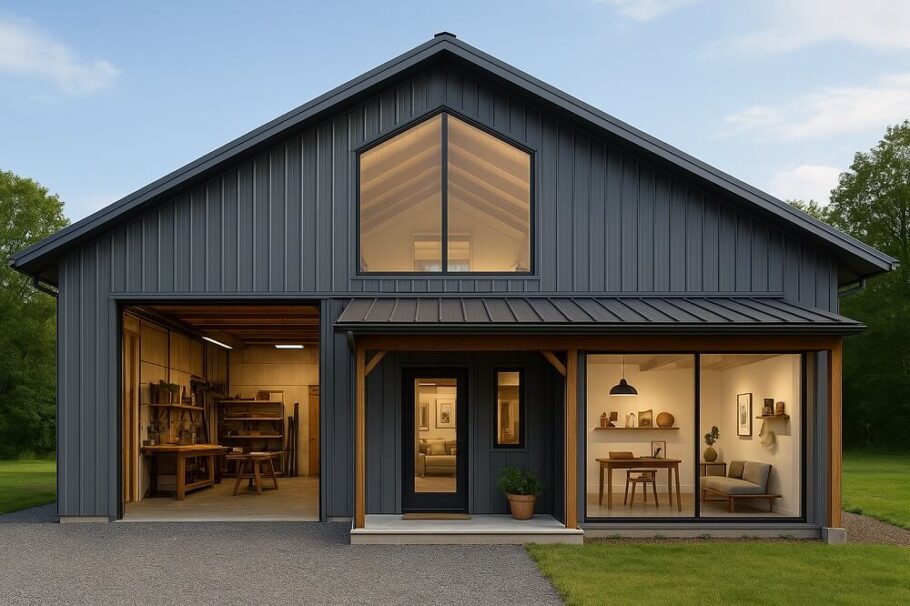
There’s a reason barndominiums have exploded in popularity. The open floor plan, the soaring ceilings, the industrial-chic aesthetic—it’s the epitome of modern, flexible living. You get that massive great room where the kitchen flows into the living area flows into your home office, all under a single roof truss. It feels like freedom.
If you live in a barndo, you know the struggle. That wide-open concept that looks incredible in photos becomes an acoustic nightmare the moment your partner is watching Dune: Part Two in the living room while you’re trying to wind down in the bedroom. Because in a traditional stick-built home, you have hallways, doors, and interior walls stuffed with insulation acting as buffers. In a barndominium, the bedroom is often just a volume within a larger volume.
Sound doesn’t travel through walls in a barndo; it travels through the air and rattles through the metal. If you want to soundproof a barndominium bedroom, you have to stop thinking like a traditional builder and start thinking like a recording studio engineer. You aren’t just putting up a wall; you are building a building inside your building.
Here is how to create an oasis of silence in the middle of your steel-framed echo chamber.
The Core Problem: Flanking Paths
Before you buy a single roll of insulation, you need to understand the physics of what you’re fighting. In a barndominium, the enemy is what acousticians call flanking.
In a normal house, sound travels through a wall, hits the studs, and dissipates. In a barndo, you likely have a concrete slab foundation and steel studs or wood posts that run continuously from the floor to the ceiling. Steel is a brilliant conductor of sound. If your bedroom walls are attached to the same metal frame that holds up the roof, every footstep in the loft, every clang of a pan in the kitchen, travels through the structure and re-radiates inside your bedroom.
You can put up the thickest drywall in the world, but if you screw it directly into the same studs that are vibrating from the living room stereo, you’ve wasted your time. Soundproofing a barndominium bedroom requires decoupling. You have to break the physical connection between the noisy structure of the main barn and the sanctuary of your sleeping quarters.
Step 1: Build a Room Within a Room
If you are in the finishing stages of your build, or even if you’re retrofitting, the gold standard is to frame your bedroom as a fully independent structure.
Imagine your barndominium is a big metal box. You want to build a wooden box inside it that touches the main structure as little as possible. This means framing interior walls with standard lumber (2×4 or 2×6) that sits on the concrete slab but stops about a half-inch short of the ceiling joists. You fill that gap with acoustic sealant or backer rod.
Why? Because if your bedroom wall runs all the way up and screws into the same steel trusses holding up the roof, the sound of rain hammering on that metal roof will travel down the truss, into the wall cap, and down the studs. By leaving a gap and using a flexible sealant, you create a break in the vibration highway.
For the ceiling, this is non-negotiable. Most barndos have exposed ceilings in the main area, but for the bedroom, you need a dropped, decoupled ceiling. Use resilient channels or hat channels. These are metal strips that you screw into the ceiling joists, and then you screw your drywall to the channels, not the joists. This creates a spring-like buffer. When sound hits the ceiling, the channels flex slightly, absorbing the energy instead of transferring it up into the cavernous steel roof above.
Step 2: Seal the Envelope Like a Submarine
This is the step that separates amateurs from pros. You can spend $10,000 on mass-loaded vinyl and double drywall, but if you have a quarter-inch gap under the door or a recessed light fixture that isn’t sealed, you’ll hear everything.
In an open-concept barndo, air leaks are sound leaks. Because the main living area is a vast echo chamber, the air pressure changes frequently (doors opening, HVAC kicking on). That pressure pushes sound through the smallest cracks.
You need to approach your bedroom like a submarine or a recording studio.
- Acoustic Caulk: Every. Single. Seam. Where the bottom plate of your wall meets the slab, seal it. Where the drywall meets the window frame, seal it. Where electrical outlets are cut into the wall, you need to put putty pads (like putty packs for firestopping) in the electrical box to seal the holes where wires enter. Standard electrical boxes are essentially little megaphones drilled into your quiet room.
- The Door: In a traditional home, a solid core door does a decent job. In a barndo, a standard hollow-core door is useless. You need a solid core door, preferably a fire-rated solid wood door, which is heavy as hell. But the door itself is only half the battle. You must install an automatic door bottom (a sweep that drops down when the door closes) and weatherstripping on the entire jamb. When that door closes, it should feel like closing a bank vault—there should be a slight resistance from the air pressure inside the room.
Step 3: Mass Is Your Friend (But Mass-Loaded Vinyl Is Your Best Friend)
Decoupling stops the vibration, and sealing stops the air leaks, but you still need to stop the sound waves themselves. Sound waves are energy, and the only way to stop energy is with mass.
Drywall is mass, but standard ½-inch drywall isn’t enough when you’re dealing with the acoustics of a wide-open metal building. You need to go thick, and you need to use layers.
Consider using Mass-Loaded Vinyl (MLV) . It’s a dense, heavy rubber sheet that comes in rolls. It’s miserable to work with—it’s heavy, it’s floppy, and it’s expensive—but it is the most effective material for stopping sound in a thin assembly.
A typical high-performance assembly for a barndominium bedroom wall (from the bedroom interior outward) would look like this:
- Fabric or finish layer (if you want it pretty).
- First layer of 5/8-inch Type X drywall (this is denser than standard drywall).
- A layer of Green Glue (a viscoelastic compound that never fully cures; it converts sound vibrations into micro-heat).
- Second layer of 5/8-inch Type X drywall.
- The stud cavity filled with Rockwool (mineral wool). Do not use fiberglass. Rockwool is denser and actually has sound-dampening properties beyond just thermal insulation.
- Mass-Loaded Vinyl stapled to the exterior side of the studs (the side facing the noisy barn).
- Another layer of drywall on the outside (the “barn side”).
Yes, this eats up square footage. Yes, it is heavy (ensure your slab can handle the load, though most barndo slabs are thick enough). But the result is a wall that feels like a concrete bunker. It stops the low-frequency thump of a subwoofer, which is usually the hardest thing to kill.
Step 4: Address the Windows and Sliders
Barndominiums love big windows and sliding glass doors. They look great, but they are acoustic weak spots.
If your bedroom has a sliding glass door leading to a patio or overlooking the main living area (if it’s a loft situation), you are fighting a losing battle. Single-pane glass has an STC (Sound Transmission Class) rating of about 25. That means normal conversation is clearly audible. A typical insulated wall has an STC of 40 to 50.
You have a few options here, none of them cheap.
- Laminated Glass: If you are still in the build phase, specify laminated glass for your bedroom windows and doors. This is the same glass used in car windshields. It has a plastic interlayer that kills vibrations. It can boost the STC rating into the high 30s or low 40s.
- Acoustic Window Inserts: If you already have the windows installed, you can buy acrylic inserts that mount magnetically inside the existing frame. These create a trapped air gap that dramatically increases sound isolation without requiring you to tear out your beautiful windows.
- Coverage: Honestly, sometimes the most practical solution for a barndominium bedroom is heavy, floor-to-ceiling acoustic curtains. Not the cheap “blackout” curtains from a big box store, but actual theater velour with a mass-loaded vinyl liner. They don’t look super modern, but they allow you to open the space up during the day and seal it off at night.
Step 5: The Mechanicals (HVAC and Plumbing)
One of the most overlooked aspects of barndo soundproofing is the ductwork. Because barndos often use exposed spiral ductwork for HVAC, if that duct runs through the bedroom or passes over the wall, it acts as a intercom system. Sound from the living room travels up the return vent, through the metal duct, and right out the supply vent in your bedroom.
If possible, use a mini-split system for the bedroom that is completely independent of the main HVAC. This eliminates ductwork entirely.
If you have to share ductwork:
- Install a duct silencer (sound trap) on the line feeding the bedroom.
- Use flexible insulated ducting (the flex stuff) for the last 4 to 6 feet before the vent. The fabric and insulation inside kill the sound waves traveling down the metal pipe.
- For plumbing, if your bathroom shares a wall with the main living area, wrap the drain pipes with pipe wrap insulation. The sound of water rushing through PVC is surprisingly loud in a metal building.
The Aesthetic Compromise
I have to be honest with you: if you follow these steps to the letter, your bedroom will not look like the rest of your barndominium. The rest of your barndo probably has exposed spray-foamed rafters, polished concrete floors, and maybe even corrugated metal accents.
Your soundproofed bedroom will have a dropped ceiling (losing that lofty height), thick drywall, heavy doors, and likely carpet or large area rugs (because hardwood or concrete floors are acoustic mirrors).
You have to decide if you want the look of a barndo in your bedroom, or the quiet of a bedroom.
In my experience, the best approach is to lean into the compromise. Build your decoupled walls and then clad them in something that matches the aesthetic. Use tongue-and-groove cedar over your double drywall to warm it up. It adds a little extra mass, too. Keep the dropped ceiling but use reclaimed barn wood beams to make it look intentional rather than like a low office ceiling.
Final Thoughts
Soundproofing a barndominium bedroom isn’t a weekend project, and it isn’t cheap. It’s a physics problem. You are essentially building a commercial-grade acoustic assembly inside a structure that was originally designed to store tractors—which are loud.
But if you value your sleep, your sanity, and your relationship with whoever is watching TV in the great room at midnight, it’s worth every penny. Start with decoupling. Obsess over the seals. Add mass until your back hurts. And for goodness’ sake, don’t forget the door sweep.
When you close that bedroom door after a long day and the sound of the fridge compressor, the clanking of the metal roof expanding in the sun, and the rumble of the surround sound all vanish into a dead silence, you’ll realize you don’t just have a bedroom. You have a sanctuary. And in a barndominium, that’s the ultimate luxury.