
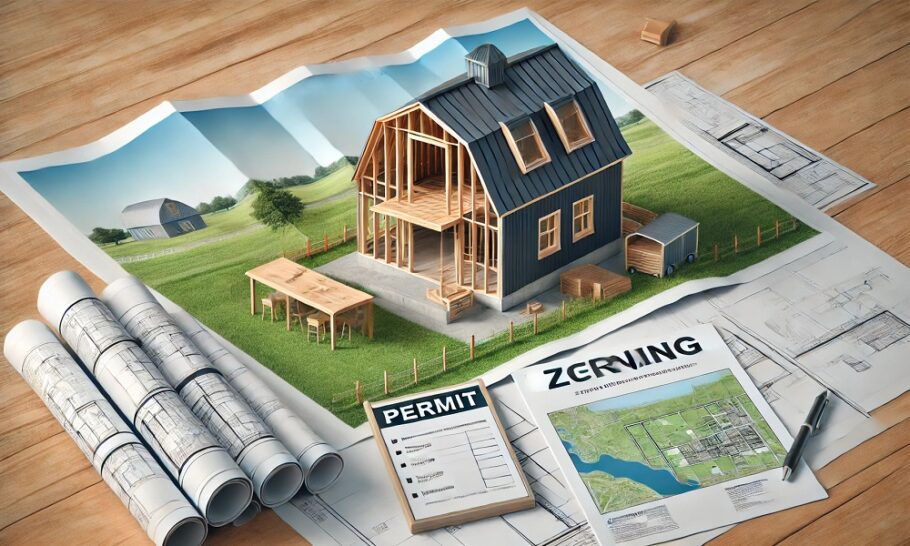
If a barndo is being planned by you, it’s already known that permits will be needed. What is overlooked by most DIYers isn’t the existence of codes—it’s how those codes interact with the unique nature of a metal building that’s trying to function as a home. Here’s what has been learned about the hidden code pitfalls that can derail your project, add thousands in unexpected costs, or leave you with a structure that’s technically not legal to live in.
Zoning: The First Gatekeeper Nobody Warns You About
It is assumed by most people that if rural land is bought, anything can be built. That’s the first misconception. Zoning regulations often have more to say about barndominiums than the actual building code does.
DIYers have been seen buying five acres in what was thought to be “unincorporated county land,” only to discover that the property falls under agricultural zoning with strict rules about primary residences. In many jurisdictions, a barndominium is classified as a “metal building dwelling,” and if the zoning doesn’t explicitly allow that, you’re dead in the water. In some counties, it is required that any primary residence have a certain percentage of exterior finish that isn’t metal—think siding, stone, or stucco. In others, a minimum square footage is mandated that your workshop area might not count toward.
Here’s a real example: A slab was poured and a shell was erected by a buddy of mine in Texas before he realized the county required any dwelling to have a pitched roof with shingles—no standing seam metal roofs were allowed in residential zones. He ended up having a conventional roof system framed over his steel frame just to satisfy zoning. That added $18,000 and three months to his timeline.
Before floor plans are even thought about, a visit should be made to the local planning department, and two questions should be asked: “Are barndominiums explicitly allowed as primary residences in this zoning district?” and “Are there any design or material restrictions I need to know about?” It should be gotten in writing. A verbal “should be fine” from a clerk isn’t going to hold up when your permit gets denied.
The International Residential Code vs. The Building You’re Actually Erecting
Here’s where things get technical, but it’s crucial to understand. Most residential construction falls under the International Residential Code (IRC). But a barndominium—especially one built with a pre‑engineered metal building (PEMB)—often straddles the line between the IRC and the International Building Code (IBC), which is typically for commercial structures.
A metal building kit is often purchased by many DIYers from a company that specializes in agricultural or commercial structures. That kit is engineered to meet certain wind and snow load requirements, but it is not engineered to meet the residential code’s requirements for things like egress, thermal bridging, or even interior wall framing.
Barndos have been walked into where the builder assumed the steel columns would serve as the interior wall structure. Then the inspector showed up and said, “You can’t attach drywall directly to those girts unless a thermal break is provided and fire‑rated assembly requirements are met.” Suddenly interior 2×4 walls are having to be framed inside the steel frame anyway—something that was thought to be skipped to save money.
What is overlooked here is that your building shell and your interior living space are often treated separately by code. The shell might meet commercial standards, but the second bedrooms, bathrooms, and a kitchen are put in, the interior must comply with IRC residential requirements. That means proper egress windows in bedrooms, smoke alarms interconnected, and specific ceiling heights in habitable spaces. Don’t assume the metal building’s engineering stamps cover the residential side of things.
Structural Surprises: Slabs, Anchors, and Point Loads
Another area where DIYers get caught is the foundation and slab. A standard monolithic slab for a house is one thing. A slab for a barndominium has to support point loads from steel columns that can concentrate thousands of pounds in a small area. If a typical residential slab is poured without thickened footings under each column, cracking, settling, or—worst case—structural failure is going to be the result.
People have been seen ordering a slab from a local concrete contractor who usually does driveways and patios. A flat 4‑inch slab is poured, then the steel building erector shows up and says, “Where are my column footings?” Now core‑drilling and underpinning—which is expensive and rarely approved retroactively—is either being done, or an argument is being had with the inspector about why the slab doesn’t match the engineered plans.
Speaking of engineered plans: if your barndo kit comes with engineered drawings, a certain slab design is often specified by them. But those drawings are for the building as a structure, not necessarily for the dwelling. Your residential permit will require its own foundation design that accounts for frost depth, soil bearing capacity, and the live loads inside. The two sets of plans need to align. When they don’t, a structural engineer is hired to reconcile them, which can cost $1,500 to $3,000 and delay you by weeks.
Electrical and Mechanical: The Post‑Frame Problem
One of the biggest oversights I see involves running utilities in a barndominium. In conventional stick‑frame construction, wall cavities exist to run Romex, plumbing vents, and ductwork. In a post‑frame barndo, you typically have exposed steel columns, girts on the exterior, and then interior walls are framed. But where do the wires go?
Many DIYers try to run electrical wiring through the steel framing, not realizing that most codes require wiring to be protected from physical damage when run through metal members. Bushings will be needed, or conduit will have to be run—which adds cost and changes your wall thickness requirements.
Then there’s the issue of grounding. A steel building requires a specific grounding electrode system that bonds the entire structure. Inspectors have been seen failing final electrical because the grounding wasn’t tied to the steel frame itself. It’s not like a wood house where a ground rod is just driven and it’s called good.
HVAC is another headache. If the entire open space—including a tall, uninsulated shop area—is being planned to be conditioned, your load calculations are going to be wildly different from a typical house. But code requires that your HVAC system be sized using Manual J calculations. If your shop area is not insulated to the same level as the living quarters, either an undersized system that can’t keep up will be installed, or an oversized system that short‑cycles and fails prematurely. DIYers have been watched installing ductless mini‑splits without proper permits, only to have the inspector require a full Manual J submission that shows the unit meets the load. When it doesn’t, equipment is swapped out.
Fire Safety and the “Mixed Occupancy” Nightmare
Here’s a code issue that can become a massive, expensive problem if overlooked: barndominiums are often considered mixed occupancy under the building code. You’ve got a residential area (sleeping, cooking, living) and a non‑residential area (the shop, garage, or workshop). These are treated differently by the code because the fire risk in a shop—where flammable liquids, welding equipment, or stored materials might be present—is much higher than in a living space.
In many jurisdictions, mixing these uses triggers requirements for fire‑rated separations. That means your shop area needs to be separated from the living area by a wall with a specific fire‑resistance rating—usually one hour—with self‑closing fire doors, no direct duct connections between the spaces, and sometimes even separate fire sprinkler systems if the shop exceeds a certain size.
DIYers have been known who planned a beautiful open floor plan with the shop visible from the kitchen, only to be told that a fully fire‑rated wall needs to be built between them. Standard windows or pass‑throughs cannot be used in that wall unless they’re fire‑rated assemblies (which are expensive and not very “open concept”). The dream of watching TV while working on your project car suddenly turns into a sealed‑off shop with a steel fire door.
The workaround—if your jurisdiction allows—is to classify the whole structure as a “dwelling” and argue that the shop is simply a garage. But even then, garages attached to dwellings have their own code requirements: the wall between the garage and living space must be fire‑rated, the garage floor must be sloped to contain spills, and there are strict rules about ignition sources (like water heaters) being elevated 18 inches above the floor.
Insulation, Condensation, and Thermal Envelope Codes
Barndominiums have a reputation for being difficult to insulate correctly, and code officials are increasingly scrutinizing this. The energy code (IECC) applies to residential dwellings, and your barndo is no exception. But the typical metal building insulation system—fiberglass with vinyl facing draped over the purlins—often fails to meet the requirements for continuous insulation or thermal bridging.
Here’s what DIYers miss: the code requires that insulation be installed in a way that provides a complete thermal envelope. If steel girts and purlins bridge from outside to inside without a thermal break, energy is being lost and condensation points are being created. In cold climates, that condensation can run down the inside of your metal walls and create mold or rust issues inside the walls. Inspections have been seen failing because the insulation was compressed behind the steel liner panels, reducing its R‑value below what was approved in the plans.
Spray foam has become the go‑to solution for many barndo builders, and for good reason—it provides an air barrier, insulation, and a thermal break all in one. But spray foam brings its own code requirements: it must be covered by a thermal barrier (like drywall) within 15 minutes of fire exposure. That means if spray foam is applied and left exposed in your shop, code is being violated unless a specific type of foam rated for exposure is used.
The bottom line: don’t assume a barndominium can be insulated the same way a pole barn is insulated. The energy code sees it as a house, and the insulation details need to be on your plans and approved before you start.
Septic and Well: The Permit Trap
This one sounds basic, but a slab has been poured and a building has been erected by DIYers only to realize a septic permit can’t be gotten because the soil percolation test failed—and now they have a building that can’t legally have a bathroom.
The oversight here is sequencing. It’s assumed by many people that because they have acreage, a septic system can be put in anywhere. But health departments require a site evaluation, and the location of your septic field is dictated by setbacks from the building, property lines, wells, and sometimes even seasonal water tables. If your barndominium has already been placed on the site without knowing where the septic field will go, it might have been placed right over the only suitable area for the leach field. Now the building is either being moved (not realistic) or a variance is being applied for (unlikely to be granted).
Same goes for wells. Minimum separation distances between wells and septic systems are strictly enforced. A DIYer has been watched having to abandon a drilled well because it was 75 feet from the septic tank instead of the required 100 feet. That was a $5,000 mistake.
Always, always get your well and septic permits—or at least the site evaluations—before the building location is finalized. Your site plan should be drawn with accurate setbacks and signed off by the health department before the slab is ordered.
The Inspection Gauntlet: Not Optional
One mindset I run into a lot is the “I’ll build it and worry about permits later” approach, especially among DIYers who come from rural areas where they think nobody will notice. Here’s the reality: if a construction loan is being gotten, permits will be required by the lender. If the property is ever sold, a certificate of occupancy will be wanted by buyers. And if construction is discovered during the process, the fines and forced remediation can be catastrophic—counties have been seen making people tear out finished walls to inspect framing and electrical.
But even if permits are pulled, DIYers often overlook the number of inspections required. It’s not just final inspection. The following will be needed:
- Foundation inspection before the pour (steel placement, footings, anchors)
- Framing inspection (including the steel structure and any interior framing)
- Insulation inspection before drywall
- Rough electrical, plumbing, and mechanical inspections
- Final inspections for each trade plus a final building inspection
If one is missed, walls might have to be opened up or your project delayed for weeks while inspectors fit you back into their schedule.
I always tell people: a relationship with your local building department should be built early. The inspector should be invited out during the planning phase if they’re willing. Most inspectors I’ve worked with appreciate DIYers who are proactive and transparent. They’d rather help you do it right than show up to a mess and have to issue stop‑work orders.
Final Thoughts: The Overlooked Budget Line
Every overlooked code issue I’ve mentioned here has a cost attached—not just money, but time, stress, and sometimes the loss of the design you really wanted. When I see barndominium forums flooded with questions like “How do I fix this after the inspector failed me?” I know that somewhere, someone didn’t ask the right questions early enough.
If the DIY route is being taken, do yourself a favor: treat code compliance not as a hurdle to clear but as a roadmap to a safe, durable, and sellable home. Money should be spent on an architect or a design professional who has done barndominiums in your area. The engineered drawings that marry the metal building structure to the residential interior should be paid for. Permits should be gotten before ground is broken, and every inspection that’s coming should be known.
A barndominium can be an incredible way to build a home that fits your life—they’ve been seen done beautifully. But the ones that go smoothly are the ones where the code was respected by the builder from day one. The rest, well, they’re the cautionary tales that are shared to help the next person avoid the same mistakes.