
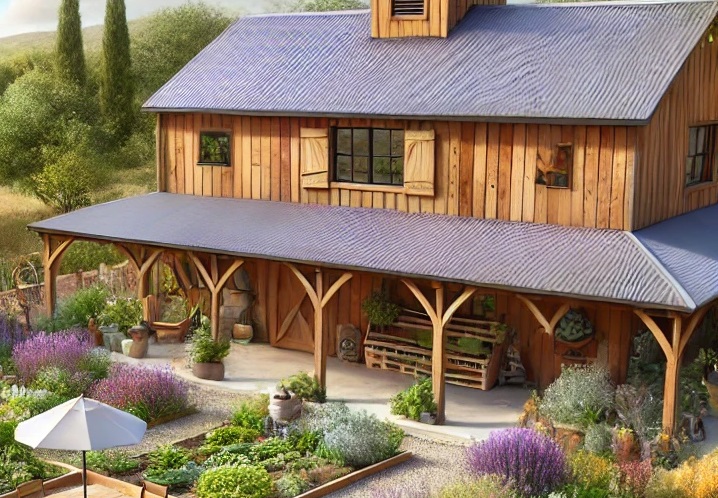
If you’re designing a barndominium, you’ve probably spent hours debating floor plans, window placement, and whether you really need that sliding barn door everyone loves. But there’s one structural decision that sneaks up on most people: roof pitch. And trust me, after building and consulting on more barndos than I can count, I’ve seen how getting this wrong can turn your dream home into a maintenance nightmare.
Roof pitch isn’t just about how your barndo looks from the road. It determines whether snow slides off or collapses your structure, whether rain drains fast enough to prevent leaks, and how much usable space you get upstairs. Let’s break down what actually works for snow, rain, and curb appeal—without the fluff.
Understanding Roof Pitch Basics
Before we dive into numbers, let’s clarify what “pitch” means. In simple terms, it’s the steepness of your roof, expressed as a ratio of vertical rise to horizontal run. A 4:12 pitch rises four inches vertically for every twelve inches horizontally. That’s considered a low-slope roof. A 12:12 pitch rises twelve inches per foot—that’s a steep 45-degree angle.
Most traditional barns use moderate pitches between 4:12 and 8:12. But barndominiums blend agricultural roots with residential needs, so the “right” pitch depends heavily on where you live and what you’re planning to do under that roof.
Snow Load: The Non-Negotiable Factor
If you’re building anywhere that gets real winter—I’m talking the Midwest, Northeast, Rockies, or even parts of the Pacific Northwest—snow load is your first and last concern. I’ve walked through barndos in Montana where the owners swore a 3:12 pitch would be fine because “it rarely snows that much.” Then came the February that dumped forty inches in a week. They spent the thaw with buckets catching drips from stress cracks.
Here’s the physics: shallow roofs hold snow. Steep roofs shed it. But there’s nuance.
For heavy snow regions (think 50+ pounds per square foot ground snow load), you want at least a 6:12 pitch, and many engineers will push you to 8:12 or higher. At 8:12, most dry snow will slide off on its own once it reaches a certain depth. Wet, heavy snow—the kind that feels like concrete—needs steeper angles, sometimes 10:12 or more, to really shed reliably.
But steep roofs come with their own headaches. Snow sliding off a 10:12 metal roof can bury your driveway, crush shrubs, or—if you’re unlucky—take out a window. I know a guy in Wyoming who installed snow guards after his sliding roof avalanche demolished his grill and bent his A/C condenser fins. So if you go steep, plan for snow retention systems.
What about shallow pitches in snowy climates? I’ve seen 3:12 and 4:12 barndos survive for decades in places like northern Michigan, but those owners either have monster trusses rated for insane loads or they’re up on the roof with a plastic shovel after every storm. The risk isn’t just collapse—it’s ice dams. Low-pitch metal roofs in snow country often develop ice at the eaves, which backs water up under the panels. That’s a leak you won’t notice until your drywall bubbles.
My rule of thumb for snow: if you get more than three feet total annually, don’t go below 6:12 unless an engineer signs off on doubled-up trusses. And if you’re in a true snow belt, 8:12 to 10:12 is your safe zone.
Rain and Drainage: Steeper Isn’t Always Better
Rain is more forgiving than snow, but it still demands respect. The main goal is moving water off the roof fast enough to prevent ponding, which is standing water that sits for hours after a storm.
Ponding is the silent killer of low-pitch roofs. On a 1:12 or 2:12 pitch, water can pool behind slight deflections in the metal panels. Over time, that ponding leads to rust at fastener points, deteriorated sealants, and eventually leaks. I’ve replaced entire roof sections on barndos with supposedly “waterproof” 2:12 standing seam roofs because the owners didn’t realize that almost-flat still isn’t flat enough for reliable drainage.
For rain-only climates—think the Southeast or Pacific Northwest where snow is rare—you can get away with a 4:12 pitch easily. That’s enough slope to keep water moving without feeling like you’re climbing a mountain when you’re up there cleaning gutters. Many production barndo kits default to 4:12 for exactly this reason.
But here’s where aesthetics and rain intersect: if you live somewhere with heavy downpours, like Florida’s summer afternoon deluges, steeper pitches actually reduce gutter overflow. At 6:12 or above, water velocity increases significantly, meaning it shoots off the roof edge with enough force to overshoot your gutters if they’re not sized right. You’ll see this on old barns—they often lack gutters entirely because the steep roof just flings rain ten feet away from the foundation.
So for rain management, the sweet spot is 4:12 to 6:12. That’s steep enough to prevent ponding and self-clean leaves and debris, but not so steep that you need heroic gutter systems.
Aesthetics: The Part Everyone Cares About Most
Let’s be honest—most people start with the look and then try to engineer around it. I’ve done it myself. You fall in love with that classic gambrel barn silhouette or the sleek modern shed roof, and suddenly snow load becomes an afterthought.
Traditional barndominium aesthetics vary by region. In Texas and Oklahoma, you’ll see tons of 4:12 to 5:12 pitches on barndos that look like slightly tall ranch houses. That low, sprawling profile fits the landscape and keeps costs down. Go to the Midwest or Northeast, and the iconic “barn look” demands steeper—usually 8:12 or even 10:12 on the main roof, sometimes with a 12:12 on dormers.
The gambrel roof deserves special mention. That classic two-slope barn roof—steep on the lower section, shallow on top—gives you the look of a very steep roof without the full height. A typical gambrel might have a 12:12 lower slope and a 4:12 upper slope. For snow, that lower steep section sheds well, but the flatter top can accumulate. You’ll need robust trusses there. For rain, gambrels work fine as long as the transition isn’t a flat valley where debris collects.
Modern barndominiums often lean into shed roofs (single-slope) or low-pitch gables. A 3:12 shed roof looks sharp and contemporary, but it’s a liability in snow country. I’ve seen architects spec 1:12 shed roofs for desert barndos in Arizona where rain is a rare guest, but those same plans would be reckless in Colorado.
One aesthetic trick that works: using a higher pitch on the front-facing gable (say, 8:12) for that classic barn presence, then transitioning to a lower pitch (5:12) over the back addition where you care less about looks. It’s not cheap because you’re framing two different roof systems, but it solves the form-versus-function battle neatly.
The Practical Trade-Offs Nobody Talks About
Beyond snow, rain, and looks, there are real-world costs and consequences to your pitch choice.
Cost. Higher pitch means more material—longer rafters, more sheathing, more metal panels. Going from 4:12 to 8:12 roughly doubles the roof surface area for the same building footprint. That’s not just more metal; it’s more labor because your crew is working on steeper slopes, which requires safety gear and slows them down. Budget an extra 30-40% for a steep roof versus low-slope.
Interior space. This is where barndominiums shine. A steeper roof gives you loft space, vaulted ceilings, or room for a second floor without adding a full story. An 8:12 pitch on a 40-foot-wide barndo creates a ridge height around 13 feet higher than the walls. That’s enough for a proper upstairs bedroom or a massive great room with exposed trusses. A 4:12 pitch gives you maybe six feet of rise—enough for storage but not living space.
Maintenance. I’ll take a shallow roof every time if I’m the one cleaning gutters or replacing a vent boot. Walking a 4:12 pitch feels like a gentle hill. Walking a 10:12 feels like you’re about to slide off into the yard. If you’re not hiring out all your maintenance, think hard about how often you’ll need to go up there.
Wind resistance. Steep roofs catch more wind, obviously. In hurricane zones or tornado alleys, engineers often prefer 4:12 to 6:12 because the wind flows over rather than pushing against a tall wall of metal. That said, modern attachment methods (screws every six inches on the gable ends) can make steep roofs handle wind just fine—it just costs more.
So What’s Actually Ideal?
After looking at hundreds of barndominiums from Texas to Maine, here’s my honest take:
For snow-heavy regions (northern states, mountains): 8:12 to 10:12 pitch, metal roof, with snow guards near entryways and gutters. You’ll pay more upfront but you won’t be shoveling your roof in February.
For mixed climates (some snow, lots of rain, Midwest/northeast valleys): 6:12 to 7:12 pitch. That’s the Goldilocks zone—steep enough to shed moderate snow, gentle enough to walk on, and classic enough to look like a real barn.
For rain-only or low-snow regions (south, Pacific coastal, desert): 4:12 to 5:12 pitch. Save your money, make maintenance easy, and enjoy the clean lines.
For pure aesthetics with no regard for weather (maybe you’re building in Southern California): Do whatever you want. I’ve seen 12:12 barndos that look like church steeples and 1:12 modern sheds that look like art installations. Just know what you’re signing up for.
Don’t Forget Local Codes and Engineering
One last thing that trips up DIY barndo builders: your local building department might make this decision for you. Many snow-country jurisdictions have minimum roof pitch requirements for metal roofs—sometimes 4:12 or even 6:12 as a baseline. And even if they don’t, your truss manufacturer will require engineered drawings that factor in ground snow load. You can’t just tell them “I want a 3:12 pitch” in a 70-psf snow zone. They’ll laugh (politely) and then refuse to stamp your plans.
My advice? Find a local structural engineer who’s done barndominiums before. Pay them for an hour of their time to review your site and your dream pitch. That hundred-dollar consult will save you thousands in rework or, worse, a sagging roof ten years from now.
The Bottom Line
There’s no single ideal roof pitch for every barndominium. The right choice balances your local climate, your budget, your desire for loft space, and the look that makes you smile when you pull in the driveway. Start with snow and rain—those are structural necessities, not preferences. Then work backward to the pitch that gives you the aesthetics you love without compromising safety.
And if you’re still torn between a 6:12 and an 8:12? Go with the steeper one. I’ve never met a barndo owner who wished their roof was shallower after a wet spring or a heavy winter. But I’ve met plenty who wished they’d gone steeper while standing ankle-deep in a leaky living room.