
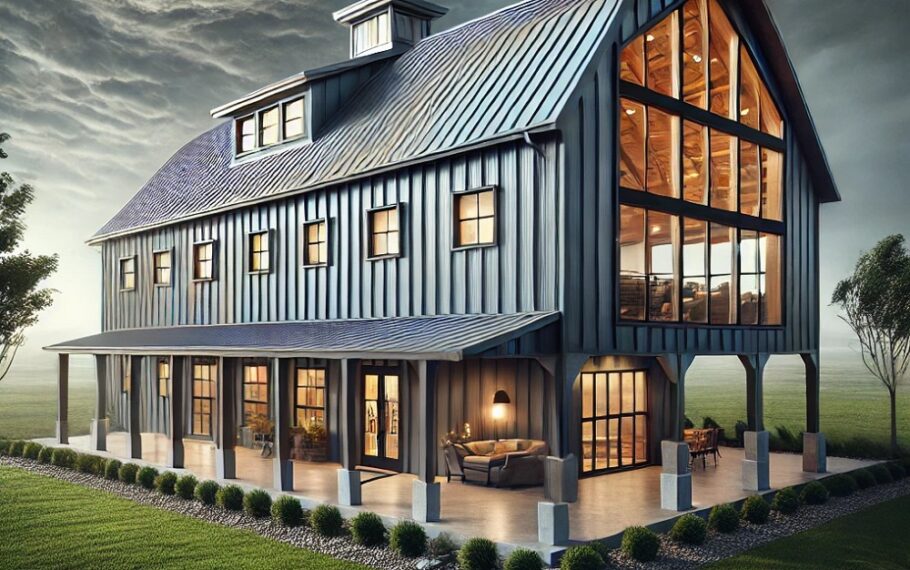
You’ve spent months scrolling through Pinterest, saving photos of gorgeous barndominiums with their clean lines, vaulted ceilings, and that perfect blend of rustic and modern. You found a piece of land, talked to a builder, and started dreaming about the workshop-guest suite-open concept living space that’s going to be your forever home. Then your well-meaning neighbor—the one who built his own barndo three years ago—says something like, “Just use my plans. The county signed off on them. You’ll be fine.”
And honestly? That advice sounds tempting. Engineering reports cost money. Structural calculations take time. Copying what’s already standing next door feels like a shortcut that skips the headache and the expense.
But here’s the hard truth: using your neighbor’s snow load calculations for your barndominium isn’t just risky. It’s a gamble with the structural integrity of your entire home. Snow doesn’t fall evenly, roofs don’t behave identically, and the difference between “fine for him” and “catastrophic for you” can come down to factors you’d never guess just by looking next door.
Snow Loads Aren’t One-Size-Fits-All, Even on the Same Street
Let’s start with the obvious thing most people miss. The ground snow load number in your local building code—say, 40 pounds per square foot—is a regional baseline. But that number assumes open, flat terrain with no unusual conditions. Your property and your neighbor’s property might sit on the same road, but that doesn’t mean they share the same site-specific snow load.
Think about roof shape. Your neighbor built a simple gable roof with a 6:12 pitch. You want a more dramatic 12:12 pitch for a lofted bedroom. Steeper roofs shed snow differently. They also accumulate unbalanced snow loads on the leeward side when wind blows across the ridge. Your neighbor’s calculations assumed his pitch. Yours will need different values for drifting and sliding snow.
What about roof geometry? Barndominiums often feature multiple roof elevations—a lower porch roof, a main living area roof, and maybe a clerestory or monitor roof for natural light. Every change in height creates a potential drift zone. Snow blows off the higher roof and piles up on the lower one, sometimes reaching two or three times the base snow load. Your neighbor’s simple single-slope or basic gable design might not have any of those transition points. Copy his numbers, and you’ve just ignored a concentrated load that could literally crush your porch structure.
The Drifting Problem Nobody Talks About
Drifting is where most DIY snow load mistakes happen. When wind moves across an open field, it picks up snow and drops it in predictable patterns. But throw a building into that field, and everything changes. The wind accelerates around corners, scours snow from some areas and dumps it in others.
Imagine your neighbor’s barndo sits at the south end of a forty-acre hayfield. Prevailing winter winds come from the northwest, so his building gets scoured on the windward side and sees minimal drifting. Your property is two hundred yards north, tucked against a treeline. Those same northwest winds hit the trees first, slow down, and dump snow right onto your roof. Same street, same code, completely different loading.
Then there’s the question of adjacent structures. Maybe your neighbor has no other buildings nearby. You’re planning a detached garage, a horse barn, and a chicken coop within thirty feet of your barndo. Those outbuildings create wind shadows and turbulence that can cause erratic snow accumulation. Your main roof might see extra drift from snow sliding off the garage roof. None of that exists in your neighbor’s calculation.
Thermal Effects: Heated vs. Unheated Changes Everything
Here’s a subtle one that trips up almost everyone. Your neighbor built his barndominium with a heated slab and spray foam insulation in the roof deck—a “hot roof” assembly. The warmth escaping through his roof keeps snow melting gradually, so the maximum accumulation rarely hits the full design load.
You’re planning an unheated workshop area in part of your barndo, with a cold roof assembly and vented attic space above the living quarters. Snow sits on that roof for weeks without melting. The thermal factor in the ASCE 7 standard (the national engineering guideline for loads) can increase your required snow load by twenty percent or more compared to a heated structure.
If you copy your neighbor’s numbers without adjusting for thermal effects, you’re essentially designing for a building that stays warm. Yours doesn’t. That’s a recipe for deflection, sagging rafters, and eventually—if you get a really bad winter—structural failure.
The Importance Factor: What Happens When Things Go Wrong?
Building codes classify structures by risk category. Most single-family homes, including barndominiums, fall into Risk Category II. That means the code assumes a low risk to human life if the building fails. But here’s the catch: your neighbor might have built a simple shop with a small living quarters, essentially an accessory structure. You’re building a full-time residence where your family sleeps every night. The importance factor for snow load—typically 1.0 for a standard home—might actually be higher if your barndo also serves as an emergency shelter, a farm operation hub, or if you live in an area with limited first responder access.
Some jurisdictions require a higher importance factor for agricultural barndominiums that house livestock or equipment critical to your livelihood. Your neighbor’s weekend hunting lodge didn’t need that. Your working farm barndo might.
Exposure: Open Fields vs. Sheltered Lots
The exposure factor accounts for how much wind scours snow off your roof before it can accumulate. An exposed roof in a windswept field might see a significant reduction in design load because the wind never lets snow build up. A sheltered roof surrounded by trees, terrain, or other buildings keeps more snow in place.
Your neighbor’s barndo sits on a bald hilltop with no windbreaks. His exposure factor might be 0.8 or 0.9, reducing his required design load by ten to twenty percent. Your lot is down in a hollow with dense pines on three sides. Your exposure factor is 1.0 or even 1.1 because the trees block wind but don’t block snowfall. Copy his load calculation, and you’ve just underestimated your actual snow accumulation by a significant margin.
Real Consequences: What “Just Copy the Neighbor” Actually Costs
Let me tell you about a barndo in upstate New York that followed this exact logic. The owner looked at his neighbor’s 50 psf design, assumed it would work for his own building, and saved about $1,500 on engineering fees. Three years later, a series of wet, heavy storms dumped snow that drifted against a parapet wall—a feature his neighbor didn’t have. The trusses failed along a thirty-foot section. The roof didn’t collapse completely, but it sagged badly enough to crack drywall, bind doors, and require $18,000 in temporary shoring plus a full truss replacement.
His insurance adjuster asked for the structural calculations. He didn’t have any. The county building department had accepted his permit application based on a stamped letter from his neighbor’s engineer—a letter that explicitly stated the calculations were for a specific address and roof geometry. That’s when he learned that engineering stamps aren’t transferable. His claim was denied for unpermitted modifications (the parapet) and lack of documented design. He paid out of pocket.
Another case out of Colorado: a barndo owner copied snow load numbers from a similar building a quarter mile away. What he didn’t know was that his property sat in a microclimate where lake-effect patterns added thirty percent more annual snowfall. The first winter, snow slid off his metal roof and piled up against a sliding barn door, buckling the track. The second winter, an ice dam formed because his eave detail wasn’t designed for the freeze-thaw cycles in that specific spot. Water backed up under the metal panels and rotted the OSB sheathing.
These aren’t freak accidents. They’re predictable failures caused by assuming that “close enough” works for structural engineering. It doesn’t.
How to Do Snow Load Calculations Right
Start with the ground snow load from the nearest weather station or your local building code. That’s your baseline. Then hire a structural engineer—not a general contractor, not a truss supplier’s sales rep, an actual licensed engineer—to calculate your roof snow load using the ASCE 7-22 standard (or whatever version your state adopts).
The engineer will need:
- Your exact roof geometry, including pitch, overhangs, parapets, and any changes in elevation
- The location and height of any nearby trees, buildings, or terrain features
- Your building’s thermal envelope: which areas are heated, which are unheated, and how the roof assembly is vented
- The slippery-ness of your roofing material (metal sheds snow more easily than asphalt shingles, but that also creates sliding snow hazards below)
- Your building’s risk category and importance factor
That sounds like a lot. It is. But it’s also a one-time cost that protects a six-figure investment.
The One Exception That Proves the Rule
There is exactly one scenario where copying your neighbor’s snow load calculation might work: if you build the exact same building, on the exact same site, with the exact same orientation, thermal characteristics, roof geometry, and surrounding terrain. Which is to say, if you build an identical barndominium on your neighbor’s lot after he moves away. Otherwise, you’re guessing.
And here’s the thing about guessing with snow loads: you don’t know you guessed wrong until the heaviest snow in a decade hits. That’s the nature of low-probability, high-consequence events. Your roof might survive nine winters just fine. The tenth winter, the drifting patterns line up, the snow density is higher than usual, and the load exceeds your design by forty percent. That’s when rafters crack, welds break, and barndominiums become piles of twisted metal and splintered wood.
Don’t Let Shortcuts Cost You Everything
I understand the impulse to copy what works. Building a barndominium is expensive, and engineering fees feel like an unnecessary luxury when your neighbor’s building is right there, standing solid. But structural engineering exists because buildings fail in ways that aren’t obvious to the untrained eye. Your neighbor’s barndo isn’t standing because his calculations were perfect—it’s standing because his specific combination of site, design, and weather hasn’t exceeded his safety margin yet. Yours might be different.
Pay for the site-specific snow load analysis. Get the stamped drawings. Build with confidence that your barndominium can handle whatever winter throws at it.