
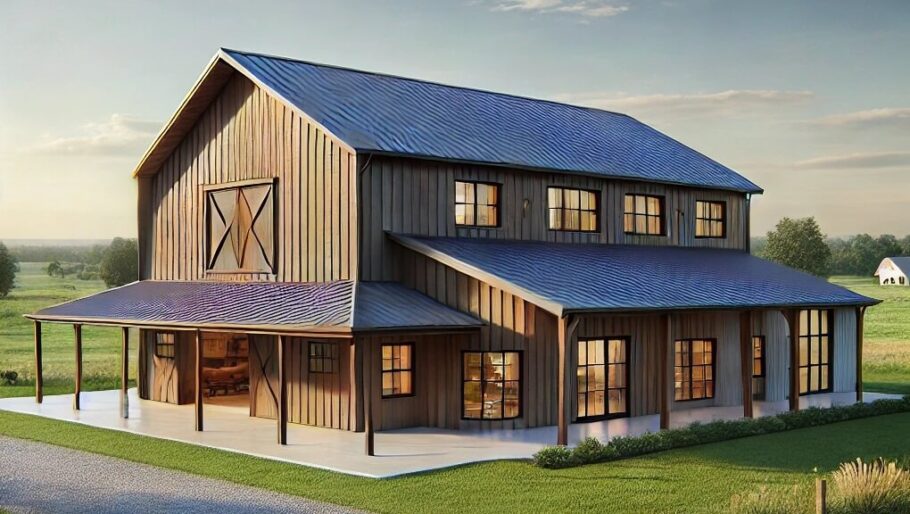
If you’re reading this, you’ve likely either taken the plunge into the barndominium lifestyle or you’re deep in the planning stages, scrolling through Pinterest boards filled with sprawling metal roofs, exposed beams, and wide-open floor plans. There’s a lot to love about barndo living. The durability, the energy efficiency when done right, and that distinct blend of rustic and industrial aesthetics are hard to beat.
But here’s something that often gets overlooked in the excitement of choosing sliding barn doors and spray foam insulation: radon.
There’s a persistent myth floating around the post-frame construction world that if you build with steel and concrete, you’re somehow immune to the geological realities beneath your slab. The logic seems sound on the surface—metal doesn’t rot, it’s tight, it’s modern. But radon doesn’t care what your walls are made of. It cares about pressure, about pathways, and about where you’re breathing.
If you’re building a barndominium, or if you’re living in one right now, we need to have a serious conversation about whether your metal home needs a vent system. Spoiler alert: the answer is almost always yes, but the way you go about it looks very different than it does in a traditional stick-frame house.
The Science of the Gas
Before we talk about steel siding and concrete slabs, let’s get one thing straight: radon is a naturally occurring radioactive gas. It comes from the decay of uranium in the soil. It’s everywhere. When it’s outdoors, it dissipates into the atmosphere and doesn’t cause harm. The problem arises when it gets trapped inside a structure.
The primary driver of radon entry isn’t the material of your walls; it’s the stack effect. Warm air rises. In the winter, when you’re heating your barndominium, the air inside becomes buoyant. It rises up through the structure, escapes through any leaks near the roof, and creates a vacuum at the lowest level of the home. That vacuum pulls soil gases—including radon—up from the ground and through the cracks, seams, and penetrations in your concrete slab.
Now, add in the fact that most modern barndominiums are built with closed-cell spray foam insulation. While this is fantastic for energy efficiency and creating an airtight thermal envelope, it also increases the stack effect. The tighter the building, the stronger the vacuum pulling from the soil. So, ironically, the very thing that makes your metal home comfortable and efficient is the thing that makes it more susceptible to drawing radon inside.
Why “It’s Just a Metal Building” is a Dangerous Mindset
I’ve walked onto build sites where the contractor waved off the idea of radon mitigation with a comment like, “It’s just a pole barn; it’s not airtight enough for radon.” This is dangerous misinformation.
First, barndominiums are not your grandfather’s pole barn. They are finished living spaces. They have drywall, finished floors, spray foam, and HVAC systems designed to condition the air. Once you seal that metal shell with insulation and interior finishes, it becomes a highly efficient structure. Efficiency equals tighter envelopes. Tighter envelopes equal higher radon potential.
Second, the floor is the issue. Regardless of whether you have a monolithic slab, a floating slab, or a pier-and-beam foundation with a concrete floor, the point of entry is the interface between the earth and your living space. Barndominium slabs are often large, expansive, and poured directly over gravel and dirt. Without a mitigation system in place, that slab acts like a giant lid sitting on top of a pressure cooker of soil gas.
The Unique Challenges of Barndominium Construction
If you are in the pre-construction phase, you have a golden opportunity. Retrofitting a radon system into an existing barndominium is possible, but it’s a pain. It involves core-drilling through finished floors, running PVC pipe up the exterior (which can mess with that clean metal aesthetic), and dealing with the fact that your slab might not have the necessary gravel layer underneath to allow gas to move freely to a suction point.
Here’s what makes barndo mitigation distinct:
- The Slab Prep Matters
In traditional residential construction, radon professionals love to see a 4-inch layer of clean, permeable gravel under the slab with a vapor barrier. In barndominium construction, because the structures are often built by agricultural contractors rather than residential developers, the soil prep can vary wildly. Sometimes the gravel layer is thin. Sometimes there is no vapor barrier. If you’re building now, insist on a “radon-ready” rough-in. This costs a fraction of a retrofit. It involves laying a perforated pipe loop in the gravel before the pour, running a PVC stack up through the framing (or up the side of the interior wall), and labeling it. Even if you don’t hook up a fan today, you’ve saved yourself thousands of dollars and a major headache down the road. - Aesthetics and the Exterior Shell
Let’s talk about curb appeal. One of the main draws of a barndominium is that clean, sleek metal exterior. If you have to retrofit a radon system, the standard method is to run a 3-inch or 4-inch PVC pipe up the side of the house and out through the roof. On a traditional home, you can hide this in a closet or paint it to match the siding. On a metal building, exposed white PVC pipes can look like a plumbing mistake. However, an expert mitigator can work with this. We can use metal downspouts to conceal the pipe, paint the PVC to match your panel colors exactly, or run the vent internally through a chase if your floor plan allows. The key is planning for it before the drywall goes up. - The “Shop” vs. “Living” Dynamic
Many barndominiums feature an attached shop or garage area that shares a common wall—or even a common slab—with the living quarters. Radon doesn’t respect the boundary between where you park your truck and where you sleep. If the shop slab isn’t mitigated, it can act as a massive entry point for radon, which then migrates through wall cavities, utility penetrations, or simply through the air pressure differences into the living space. If your barndo has an attached shop, the mitigation strategy often needs to encompass the entire slab footprint, not just the footprint under the drywall.
Testing: The Only Way to Know
I can’t tell you how many times I’ve heard, “But we don’t feel like there’s radon.” You can’t feel it. You can’t smell it. You can’t see it. It is chemically inert and invisible.
If you are living in a barndominium right now and you do not have a radon mitigation system, you need to test immediately. Do not assume that because the construction is new, it’s safe. In fact, new construction often tests higher than old, drafty homes because of that tight envelope we discussed.
You have two options for testing:
- Short-term tests: These are available at hardware stores or online. You place a charcoal canister or an electronic monitor in the lowest livable area (the master bedroom on the main floor, or the basement if you have one) for 48 to 90 hours. If the result is 4.0 pCi/L or higher, the EPA recommends mitigation.
- Continuous monitors: I highly recommend investing in a digital radon monitor for barndominium owners. Because these homes often have large, open spaces and high ceilings, the stack effect can fluctuate wildly based on weather, barometric pressure, and whether you have the overhead doors open to the shop. A continuous monitor gives you long-term data and alerts you if levels spike during specific weather conditions.
Designing the Mitigation System
If you test and find high levels (or if you are building proactively), what does mitigation look like for a metal home?
The most common and effective method is Active Soil Depressurization (ASD) . This is the “vent system” the title refers to.
In a traditional home, we usually drill a hole in the basement floor or go through the slab in a closet. In a barndominium, the approach is similar but requires attention to the structural engineering.
Sub-Slab Suction:
We core-drill through the concrete slab (usually in a mechanical room, a closet, or a corner of the garage where the pipe won’t be an eyesore). We dig a small pit under the slab, insert a pipe, and seal it tight with hydraulic cement. That pipe runs up to a radon fan—which is typically located in the attic, on the exterior, or in the unconditioned space of the shop. The fan runs 24/7, creating a vacuum under the slab. Instead of radon being pulled up into your home, it is pulled out from under the slab and vented safely above the roofline.
Sealing:
A fan is only part of the equation. We also need to seal the “pathways.” In a barndominium, this means caulking the perimeter expansion joints where the slab meets the metal walls. It means sealing cracks in the concrete. It means ensuring that any floor drains have traps that hold water to block air, or if they are unused, that they are sealed properly.
The “Metal” Factor: Does it Help or Hurt?
A common question I get is, “Does the metal roof or siding act as a shield?”
No. Absolutely not. Radon is a gas. It moves through air. Metal does not stop gas. In fact, metal buildings often have a lower profile than two-story traditional homes, but they make up for it in square footage. A sprawling, single-story barndominium with a massive slab sitting directly on the ground has more square footage of soil contact than a two-story Victorian on a basement. More contact area equals more potential entry points.
However, there is one way the metal construction helps. Because barndominiums typically utilize steel framing and metal roofs, the roof structure is often simpler to penetrate than tile or complex asphalt shingle roofs. Running the exhaust vent through a metal roof is straightforward for a professional, and it’s easier to seal water-tight using boot flashings designed for corrugated panels.
Aesthetic Mitigation Strategies
If the idea of PVC pipes ruining the clean lines of your barndominium keeps you up at night, let me reassure you. We’ve gotten creative.
For new builds, we often run the radon pipe inside the wall framing—whether that’s wood studs or steel studs—and up through a soffit or a chase that matches a decorative column. If the building has a cupola or a decorative roof peak, we can sometimes terminate the vent there, hiding it entirely.
For retrofits, we use a technique called “exterior concealment.” We build a metal chase that matches the color and ribbing of your barndo siding. The PVC runs inside this chase. To the untrained eye, it just looks like a downspout or a structural post. It blends in rather than standing out as a plumbing fixture.
The Bottom Line
Does your metal home need a vent system? It needs a radon system. Whether that system is a passive vent pipe ready for a fan, or an active fan running right now, depends on your test results. But the presence of metal siding and a steel roof does not exempt you from the laws of physics.
If you are planning a build, treat radon mitigation like you treat insulation. It isn’t an “add-on” or a luxury. It is a fundamental component of healthy indoor air quality. Budget for the rough-in. Talk to your concrete contractor about vapor barriers and gravel depth. Ask your architect or builder to allocate a chase for the piping.
If you are already living in a barndominium, go buy a test kit today. Not next week, today. I’ve tested barndos in rural areas where the owners assumed the fresh country air meant safety, only to find levels of 15 or 20 pCi/L—levels that carry the same lung cancer risk as smoking multiple packs of cigarettes a day.
The barndominium lifestyle is supposed to be about freedom, space, and simplicity. Don’t let a silent, invisible gas compromise that. Whether you have to core a hole through a 6-inch slab or simply cap off a “radon-ready” stub, getting the vent system right ensures that your dream home stays healthy for decades to come.