
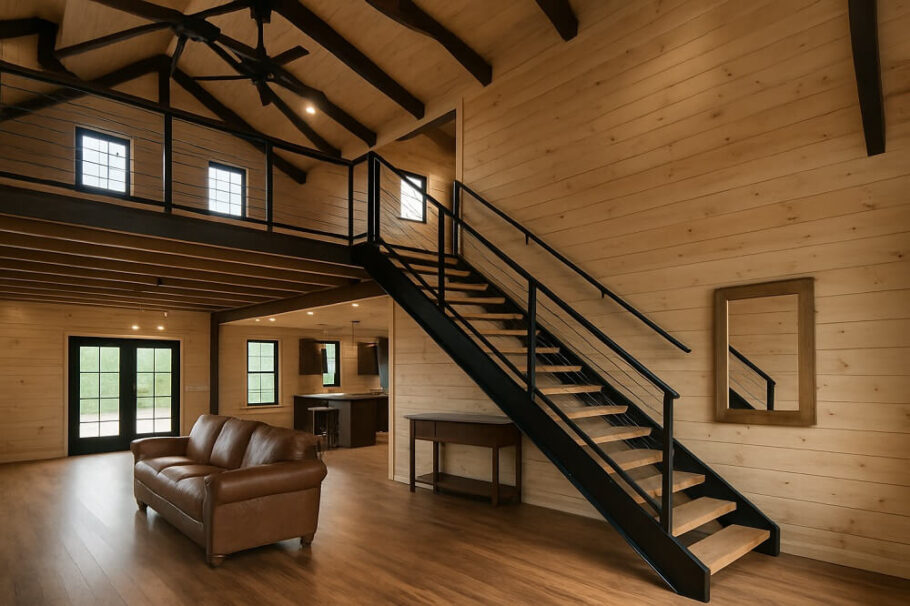
There’s a certain romance to the barndominium lifestyle. You envision wide-open spaces, vaulted ceilings with exposed steel beams, and the rugged efficiency of a metal shell wrapped around a cozy, custom home. You built or bought this structure because it promised durability and a lower maintenance lifestyle than a traditional stick-frame house.
But here’s the reality that builders don’t always emphasize: a barndo is only as strong as what’s underneath it.
I’ve been in the post-frame construction industry for over fifteen years, and if there’s one call I dread—both for my own sake and the homeowner’s—it’s the one about foundation settlement. It doesn’t happen overnight. It creeps in quietly, disguised as minor annoyances, until one day you realize your sliding glass door doesn’t latch, your pool table has developed a noticeable slope, and cracks are spider-webbing across your freshly polished concrete slab.
If you own a barndominium, or are planning to build one, understanding foundation settlement isn’t just about protecting your investment. It’s about preserving the structural integrity of a building that blends two very different engineering concepts: a massive, lightweight steel roof system sitting on a heavy, rigid concrete foundation.
Why Barndominiums Are Prone to Unique Foundation Issues
Before we dive into the warning signs, it’s crucial to understand why barndominiums face specific risks that traditional homes often don’t.
Most barndominiums are built using post-frame construction. This means large, laminated wooden posts (columns) are buried deep into the ground—often set in concrete—or mounted on a concrete foundation wall. The steel roof trusses bear down on these posts, transferring immense weight to specific points around the perimeter of the slab.
The issue arises with the “in-between” space. The interior slab—the actual floor you walk on—is usually a monolithic slab or a floating slab poured after the posts are set. Because the perimeter posts are bearing the heavy structural load of the roof, while the interior slab is simply resting on the grade, differential settlement is almost inevitable if the soil conditions aren’t perfect.
If your barndo was built on expansive clay, poorly compacted fill dirt, or in an area with poor drainage, you’re essentially watching a tug-of-war between the heavy perimeter structure and the lighter interior floor. Eventually, something has to give.
The Warning Signs: Listening to What Your Barndo Is Telling You
Foundation issues are like a chronic illness; they show symptoms long before they become critical. The trick is knowing what to look for. You don’t need a level or a laser to spot most of these issues—you just need a keen eye and a willingness to walk your space with intention.
- The Obvious: Cracks in the Slab
Not all cracks are created equal. In a barndominium, hairline cracks that appear within the first year of curing are often normal shrinkage cracks. These are superficial and rarely a structural concern.
What scares me is differential cracking. Look for cracks that have vertical displacement—meaning one side of the crack is higher than the other. If you can slide a quarter into the gap, or if the crack runs diagonally from a corner of a post or a door frame, you’re likely dealing with settlement. Pay special attention to the apron where the garage door meets the floor. If you see a gap forming there, or if the concrete is cracking near the anchor bolts of your main support posts, the clock is ticking.
- The Deceptive: Sticking Doors and Windows
Homeowners usually think their doors are swelling due to humidity. While that happens, in a barndominium, a door that suddenly sticks at the top corner is a classic sign of a racking structure.
When the foundation settles unevenly, the door frame is no longer square. If you have a set of French doors or a large sliding barn door (the irony isn’t lost on me) that used to glide smoothly but now requires a shoulder check to close, check the floor. Is there a noticeable slope at the threshold? If the floor is level but the door still binds, the settlement is likely occurring at the perimeter, twisting the entire frame.
- The Visual: Exterior Skirting Gaps
Barndominiums often have a “skirt” of concrete or stone veneer around the base to hide the gap between the ground and the metal siding. Walk the perimeter of your building after a heavy rain or during a dry spell.
If you see a gap opening up between the bottom of your metal siding and the top of your concrete skirting, that is a massive red flag. It indicates that either the foundation is sinking or the soil is heaving. In post-frame construction, if that gap is wider at one end of the building than the other, your grade beams or piers are moving independently.
- The Functional: Plumbing Fixtures and Floor Slopes
Barndominiums are known for their open floor plans. This is great for aesthetics, but terrible for hiding foundation issues. In a traditional home with many walls, a sloping floor might be isolated to a room. In a barndo, you feel it everywhere.
Set a marble or a level on your kitchen island. If it rolls toward the center of the slab, you likely have a settlement in the middle of the structure. However, if it rolls toward the exterior wall, you likely have perimeter settlement.
Also, listen to your plumbing. If you start hearing gurgling sounds from toilets or drains that used to be silent, or if you notice new leaks in PEX lines running through the slab (if you have in-slab plumbing), the shifting concrete may be stressing the pipes. A sudden unexplained water bill combined with foundation movement is a crisis waiting to happen.
The Root Causes: It’s Almost Always About the Water
In my experience, 90% of barndominium foundation settlement issues boil down to one thing: water. It’s either too much water saturating and softening the soil, or a drought causing the soil to shrink away from the foundation.
Barndominiums are often built in rural areas on agricultural land. If your builder didn’t scrape away the topsoil or compact the fill properly before pouring, you’re building on a sponge. When that sponge gets wet, it compresses. When it dries out, it cracks and contracts.
If your gutters (if you have them) discharge water right at the base of your metal siding, that water is funneling down along the outside of your perimeter posts. Over time, this hydrates the soil unevenly, causing the posts to settle faster than the interior slab.
The Fixes: From Simple Solutions to Structural Surgery
Once you’ve identified the signs, the anxiety sets in. But not every settlement issue requires selling the farm. The fix depends entirely on the severity of the movement and whether the settlement is active or dormant.
Phase 1: The Triage (Water Management)
Before you spend a dime on underpinning or mudjacking, fix the water. I cannot stress this enough. You can lift a foundation ten times, but if the water is still undermining it, you’ll be doing it again in five years.
Start by installing a proper gutter system if you don’t have one. Barndominiums often skip gutters for aesthetic reasons, but a 2,400-square-foot roof sheds thousands of gallons of water during a storm. That water has to go somewhere. Extend your downspouts at least 10 feet away from the foundation. Next, grade the soil around the perimeter. You want a slope of at least 6 inches of drop over the first 10 feet away from the building. This forces water to run away from your posts and slab rather than pooling against them.
Phase 2: Slab Jacking (Mudjacking) for Interior Slabs
If the interior of your barndo has settled, creating that dreaded “bowl” effect where the floor slopes toward the center, slab jacking is often the most cost-effective solution.
A contractor drills small holes (about 2 inches in diameter) through your concrete slab and pumps a slurry mixture—usually a combination of sand, cement, and fly ash—underneath. This hydraulic pressure lifts the slab back to its original grade. For barndominiums, this works well if the interior slab has settled but the perimeter posts and grade beams are still stable. The downside? It doesn’t address deep soil issues, and the slurry can wash out over time if water intrusion persists.
Phase 3: Push Piers and Helical Piles (The Heavy Hitters)
When the perimeter posts start sinking—or if the entire structure is moving—you need to go deep. Barndominiums are heavy. The combination of steel roofing, lumber, and concrete creates a dead load that surface-level fixes cannot support long-term.
Push piers are steel posts driven deep into the earth using the weight of the building itself as a reaction force. We drive them down until they hit load-bearing strata (bedrock or dense clay) that the original foundation wasn’t sitting on. Once they hit resistance, we bracket them to the foundation and use hydraulic jacks to lift the structure back to level.
Helical piles are similar but are screwed into the ground like a giant screw. These are excellent for barndominiums because they produce minimal vibration—critical if you already have cracks in your drywall or tile. The installation is disruptive, yes. You’re going to have excavators around your home for a few days. But this is the gold standard for stopping active settlement permanently.
Phase 4: Polyurethane Foam Injection (The Modern Alternative)
For lighter slabs or for lifting areas that don’t bear massive structural loads, high-density polyurethane foam is gaining popularity. Contractors inject expanding foam through small ports. The foam expands, compacts the soil, and lifts the concrete.
This is a great option for a barndominium’s interior living space slab if you want a quick, clean fix with minimal downtime. The foam is waterproof and doesn’t wash out like mudjacking slurry. However, it’s not typically used to lift massive post-frame perimeter foundations that are bearing the weight of the roof. Always ask your engineer if the foam has the compressive strength required for your specific load points.
Choosing Your Path Forward
If you suspect settlement, your first call should not be to a foundation repair company—it should be to a structural engineer who is familiar with post-frame construction. A good engineer will perform a series of tests: they’ll check elevations with a transit level, inspect the moisture content of the soil, and look for signs of decay in the wooden posts where they meet the concrete.
Why an engineer first? Because foundation repair salespeople are often incentivized to sell you the most expensive solution (usually piers). An engineer charges a flat fee for an assessment and gives you a unbiased repair specification. You then take that spec to contractors for bids. This ensures you aren’t paying to underpin a foundation that only needs better drainage and a few interior slab lifts.
Living in a Barndo Means Staying Vigilant
I don’t say any of this to scare you away from barndominium living. I live in one myself. The efficiency, the open space, and the unique aesthetic are unmatched. But the barndo market has exploded in the last decade, and unfortunately, the quality of site preparation hasn’t always kept pace with the demand.
If you’re building new, the fix is prevention. Spend the money on geotechnical soil testing before the forms go up. Over-engineer your foundation. If your soil is bad, spec helical piles or a reinforced monolithic slab with deeper grade beams from day one. It might add $10,000 to $15,000 to your build, but that’s a fraction of the $40,000 to $80,000 it costs to retrofit push piers after the drywall is hung and the floors are finished.
If you’re already living in a barndo and noticing the signs, don’t panic. Foundation settlement moves slowly. You have time to get a proper inspection, fix your drainage, and save for the necessary repairs. Walk your building seasonally. Check those cracks in the spring after the thaw and in the fall during the dry spell.
Your barndominium is a hybrid structure—part agricultural resilience, part residential comfort. Treat its foundation with the respect it deserves, and it will stand firm for generations. Ignore the warning signs, and that beautiful, echoing open floor plan will start to feel less like a dream home and more like a sinking ship.
Stay level, folks.