
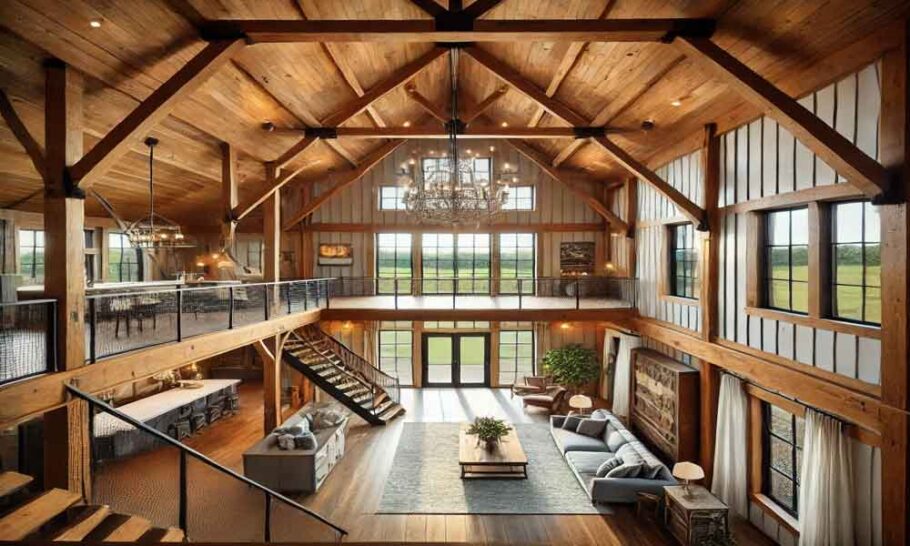
When people fall in love with the idea of a barndominium, they’re usually drawn in by the wide-open floor plans, the rustic-meets-modern aesthetic, and the promise of a structure that blurs the line between shop and sanctuary. What they don’t often fall in love with—at least not at first—are the steel framing components tucked behind the walls and resting above the ceiling. Yet if there’s one thing I’ve learned over years of working alongside builders and walking through half-finished shells, it’s that the long-term stability of a barndominium hinges on two often-overlooked elements: girts and purlins.
These horizontal members might not make it into the glossy Pinterest photos, but they are the backbone of your building’s resistance to wind, snow, and the quiet, persistent forces of settling and racking. To understand why some barndominiums stand solid for decades while others develop wavy walls, popped screws, or even structural fatigue, you have to start with how these components work—and how they’re meant to work together.
What Exactly Are Girts and Purlins?
Let’s strip away the jargon for a moment. In post-frame construction—the method used for most barndominiums—the vertical columns (or posts) carry the gravity load. But those posts can’t do their job alone. They need something to tie them together laterally and to give you something to attach your exterior cladding and interior finishes to.
That’s where girts and purlins come in.
Girts are the horizontal framing members that span between the main posts along the walls. If you imagine the skeleton of your barndominium, the girts are the ribs running horizontally across the walls. They serve two critical jobs: they brace the wall against lateral forces (like wind pushing from the outside), and they provide a nailing or fastening surface for your siding, whether that’s traditional metal panels, lap siding, or something else.
Purlins, on the other hand, live in the roof. They run horizontally across the rafters or trusses, supporting the roof deck or metal roofing panels. Just like girts, they act as both structural bracing and a substrate for your roofing material. In a well-designed barndominium, girts and purlins are the connective tissue that transforms a collection of individual posts and trusses into a unified, rigid structure.
The Stability Equation: More Than Just Holding Up Walls
When we talk about “stability” in a barndominium, we’re really talking about resistance to three main forces: wind load, snow load, and racking. A fourth, more subtle force is diaphragm action, which is how the building distributes those loads.
Let’s break those down.
Wind Load is often the dominant lateral force on a barndominium, especially in open country where these buildings tend to go up. Wind doesn’t just push against one wall; it creates pressure differences, suction on the leeward side, and uplift on the roof. Girts resist the inward and outward pressure on the walls by transferring that force to the posts and then down to the foundation. If girts are spaced too far apart or are undersized, the wall panels can “oil-can” (that wavy distortion you see on some metal buildings) or, in extreme cases, the wall can deflect enough to compromise the fasteners or even the posts.
Purlins perform a similar role in the roof, handling uplift forces that want to peel the roofing off like a sardine can lid. In areas with high wind or hurricane exposure, the connection between purlins and rafters becomes absolutely critical—a failure here can lead to a cascade of structural issues.
Snow Load is the other big vertical force that tests the roof’s integrity. While the trusses or rafters bear the brunt of the weight, purlins are the first line of defense. They span between those trusses, and if they’re undersized or spaced too far apart, they can deflect under heavy snow, causing the roof sheathing or panels to sag. Over time, that deflection can lead to leaks, fastener fatigue, and uneven load distribution that stresses the trusses in ways they weren’t designed for.
Racking is the force that tries to turn a rectangular wall into a parallelogram. Think of a picture frame that gets twisted. Without proper bracing, a barndominium’s walls can lean or shift under lateral loads. Girts—especially when combined with diagonal bracing or properly installed steel siding—create a shear panel effect that resists racking. In post-frame construction, the combination of girts and the metal cladding itself often acts as the primary shear-resisting system. If the girt spacing is inconsistent or the fasteners are improperly placed, that shear capacity drops dramatically.
The Critical Role of Spacing and Orientation
One of the most common mistakes I see in DIY barndominium builds is treating girts and purlins as an afterthought—just something to screw the metal to. In reality, their spacing and orientation are engineering decisions that affect everything from structural capacity to insulation continuity.
In traditional post-frame construction, girts are often installed flush with the outside of the posts, allowing the metal siding to attach directly. But there’s a growing trend toward bypass girts, which are installed on the inside face of the posts or on the outside with a thermal break. Each method changes how loads are transferred. Bypass girts, for instance, can create a continuous insulation cavity but require careful engineering to ensure the connection between the girt and the post is strong enough to handle wind loads without excessive leverage.
Spacing is where things get really technical. Standard girt spacing for metal siding might be 24 to 36 inches on center, but that number isn’t arbitrary. It’s determined by the gauge of the siding, the expected wind speed, and the span capacity of the girt itself. Go too wide, and you’ll get wavy walls and potential fastener pull-out. Go too narrow, and you’re wasting material and adding unnecessary weight and cost.
Purlins face the same considerations. In a roof, purlin spacing is dictated by the snow load, the type of roofing (standing seam versus through-fastened screw-down panels), and the span between trusses. A 2×6 purlin spanning 10 feet between trusses might handle a moderate snow load, but stretch that span to 12 feet or increase the snow load, and you’re looking at a 2×8 or even engineered lumber.
Material Choices: Wood vs. Steel
Barndominiums occupy a unique space in the construction world because they blend post-frame techniques with residential finishes. That means girts and purlins can be either wood or steel, and each has its own set of advantages and challenges.
Wood girts and purlins (typically #2 grade southern yellow pine or Douglas fir) are the traditional choice in post-frame construction. They’re familiar to most builders, easy to fasten into, and offer good thermal performance when paired with insulation. However, wood can warp, twist, or shrink over time, which can lead to popped screws in metal siding or gaps in the building envelope. Wood also requires careful attention to moisture content—install them too wet, and you’ll end up with waves in your walls as they dry.
Steel girts and purlins (usually C- or Z-shaped cold-formed steel) are gaining popularity because they offer unparalleled straightness, consistent strength, and resistance to rot and insects. Steel also allows for longer spans between posts, which can create more open interior spaces with fewer obstructions. The trade-off is that steel requires careful detailing to prevent thermal bridging—metal conducts heat, so without a thermal break, you can end up with condensation issues or energy loss. Steel also demands precision in fastening; you can’t just run a screw through it like you would with wood—you need proper fasteners and often pre-punched holes.
I’ve seen barndominiums that mix materials successfully, using steel girts for the walls to achieve a perfectly flat plane for siding, and wood purlins in the roof for ease of insulation and attic ventilation. The key is making sure the connections between materials are detailed correctly to handle differential movement and load transfer.
The Connection Details That Make or Break a Building
If girts and purlins are the bones, the connections are the joints. And in barndominium construction, the connections are where good buildings separate from the ones that end up with cracked drywall, stuck doors, and a whole lot of regrets.
The connection between a girt and a post is deceptively simple—often just a few nails or screws through a bracket or directly into the face of the post. But that connection has to resist both shear and withdrawal forces. In high-wind areas, engineers will specify hurricane straps or engineered metal connectors for every girt-to-post and purlin-to-truss connection. I’ve watched builders dismiss these as overkill, only to have a building inspector make them peel back siding to add them later. Don’t skip them.
Another detail that often gets overlooked is blocking—the short pieces of lumber or steel installed between girts or purlins at splices, corners, and openings. Blocking does several things: it provides a nailing surface for siding at panel edges, it transfers loads around windows and doors, and it prevents the girts from rolling or twisting under load. In a barndominium with large openings for garage doors or sliding glass walls, proper blocking around those openings is essential to maintain structural continuity.
How Girts and Purlins Affect Insulation and Interior Finishes
One of the biggest selling points of barndominiums is the ability to create a finished, conditioned space inside a metal shell. But achieving that without thermal bridging or moisture problems comes down to how you handle the girt and purlin layer.
If you’re doing a traditional “post-frame with insulation between girts” approach, the depth of your girts dictates how much insulation you can fit. Using 2×6 girts instead of 2×4 gives you room for R-19 or R-21 fiberglass or mineral wool, but you still have the thermal break of the girt itself. That’s why many high-performance barndominiums are moving toward staggered girt systems or using rigid insulation continuous across the exterior of the girts.
Purlins in the roof present a similar challenge. If you’re finishing the ceiling with drywall or tongue-and-groove, you need to think about how the purlins will support that ceiling while also providing a vented air space above the insulation. A common approach is to use deeper purlins that allow for a ventilation gap, then install insulation between them and finish the interior with a separate ceiling system attached to the bottom of the purlins or to furring strips.
I’ve walked through barndominiums where the builder skipped the interior finish considerations, attaching drywall directly to the underside of the same purlins holding the metal roof. Months later, condensation from the roof deck stained the drywall, and the fasteners started showing through as the building moved. That’s the kind of thing that happens when girts and purlins are treated as purely structural without considering their role in the overall building system.
Common Failure Points and How to Avoid Them
After looking at dozens of barndominiums—both well-built and problematic—a few recurring issues stand out when it comes to girts and purlins.
Overspacing is the number one culprit. Builders trying to save money or time will push girt spacing to 4 feet or more, assuming the metal siding will bridge the gap. It won’t. Over time, the siding will flutter in the wind, fasteners will loosen, and the wall will lose its ability to resist racking. Stick to engineered spacings, usually 24 inches for residential-grade siding and up to 30 inches for heavier commercial panels.
Misaligned splices are another issue. When two girts meet at a splice over a post, they need to be properly lapped or butted with a splice plate. If they’re simply nailed together without proper overlap, that splice becomes a weak point that can open up under load. In walls, this can lead to cracks in interior finishes; in roofs, it can lead to a visible sag in the roofline.
Fastener failure is often overlooked. Using the wrong screw for the job—like a standard wood screw in a steel-to-steel connection—is a recipe for trouble. Metal roofing and siding screws have neoprene washers and specific thread patterns for a reason. For girts and purlins, structural screws or heavy-duty nails are required, and they need to be driven to the correct depth. Overdriving can crush wood fibers or strip steel threads; underdriving leaves the connection loose.
Finally, inadequate bracing during construction can doom a building before it’s even finished. Girts and purlins don’t just serve the finished structure—they stabilize the frame during erection. I’ve seen crews try to stand walls and set trusses without enough temporary bracing, leading to a slight lean that gets locked in once the girts are fastened. That lean creates eccentric loads that the building wasn’t designed for, and it will manifest later as doors that don’t close right or walls that aren’t plumb.
The Bottom Line: Invest in the Skeleton
If you’re planning a barndominium—whether as a DIY project or with a contractor—it’s easy to focus on the finishes: the stained concrete floors, the farmhouse sinks, the reclaimed wood accent walls. But the building’s long-term stability, energy efficiency, and resistance to the elements will be determined by the bones you never see.
Girts and purlins may not be glamorous, but they’re the framework that holds your investment together. Spending a little more on proper spacing, robust connections, and thoughtful detailing around insulation and finishes will pay dividends for decades. Skimp on them, and you’ll be chasing leaks, straightening wavy walls, and wondering why your barndominium never quite feels as solid as it should.
A well-built barndominium should feel like a rock—steady against the wind, solid underfoot, and quiet in a storm. And that feeling starts not with the pretty things you see, but with the girts and purlins that hold it all together, hidden in plain sight, doing the heavy lifting day after day.