
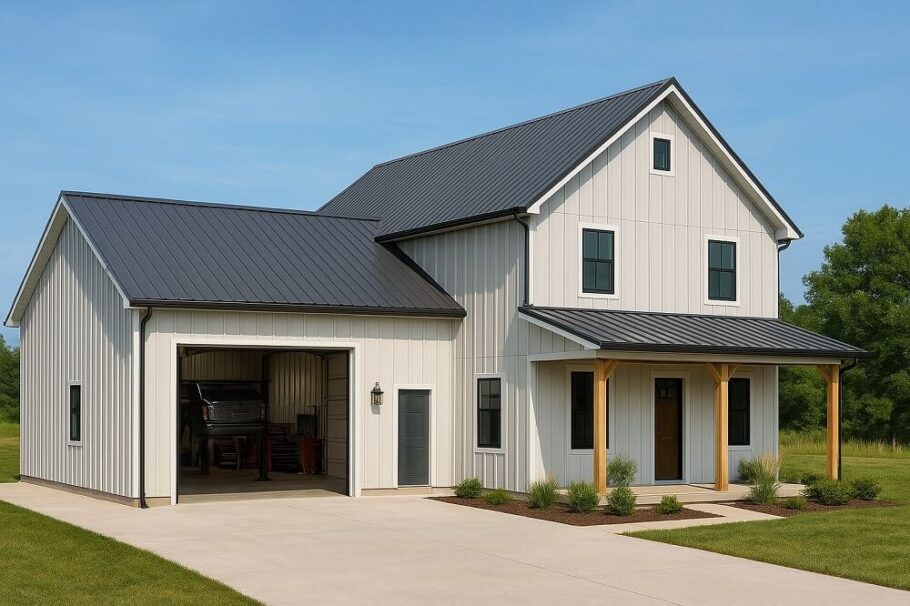
There is a common misconception in the custom building world that a “shell” is just a shell. Many prospective barndominium owners fall in love with the aesthetic first: the soaring ceilings, the endless expanse of clear-span space, and the seamless blend of rustic living with modern industrial design.
But ask any structural engineer worth their salt, and they will tell you that a barndominium is not a one-size-fits-all structure. While the architectural style may be consistent from Texas to Montana, the skeleton beneath the skin must be radically different. The moment you decide on a piece of land, that dirt, that wind, and that climate start writing the specifications for your home.
Failing to adapt your barndominium’s engineering to your specific geographic location isn’t just a bureaucratic hurdle to clear for a permit; it is a structural gamble. Here is how the map dictates the nuts and bolts of your build.
The Snow Load Vs. The Wind Load: A Tale of Two Forces
At its most basic level, structural engineering is the management of forces. A building must be able to stand up against gravity (pushing down) and lateral forces (pushing sideways). Where you live determines which of these forces is the primary antagonist.
Northern Latitudes and Heavy Snowfall
If you are building in the Rocky Mountains, the Northeast, or the Upper Midwest, your barndominium is going to war with gravity every winter. Snow loads are calculated in pounds per square foot (psf). In some regions, the ground snow load can exceed 100 psf. That is a massive weight sitting on your roof.
For a barndominium, which often utilizes wide roof spans to create that open floor plan, snow load is critical.
- Roof Pitch: Engineers in snowy regions often recommend steeper roof pitches. While a low-slope roof might look sleek, it allows snow to accumulate. A steeper pitch encourages snow to slide off, reducing the sustained load.
- Truss Design: The red iron or wood trusses in snowy climates must be engineered for “balanced” and “unbalanced” loads. Unbalanced load is the tricky part—it happens when wind drifts snow against a lower roof section or creates a deep drift on one side of the ridge. Your engineer must account for the possibility that one side of your great room roof is holding two tons of snow while the other side is bare.
- Foundation Depth: Interestingly, heavy snow loads don’t just affect the roof. They relate to frost depth. In cold climates, the ground freezes and thaws. The frost line dictates how deep your concrete piers or foundation must go. If you don’t go deep enough, frost heave can lift your barndominium’s foundation, causing cracks in the slab and shifting the load from the steel frame. Your geographic location dictates how far down you have to dig to reach stable, non-moving earth.
Hurricane Alley and Tornado Territories
Now, move to the Gulf Coast, the Atlantic Seaboard, or the Great Plains. Here, gravity takes a backseat to lateral pressure. Wind loads can exceed 150 mph in hurricane zones.
A barndominium, with its large wall surfaces and expansive roofs, acts like a sail.
- The Metal Building Rating: Standard agricultural pole barns often use “cold-formed” steel or light-gauge tubing. In high-wind areas, engineers typically specify “Red Iron” (rigid steel frame). The connections here are vital. The bolts holding the columns to the foundation must be designed to resist “uplift.” The wind doesn’t just push against the wall; it tries to suck the roof off and lift the entire structure out of the ground.
- Shear Walls and Bracing: In a traditional stick-frame home, shear walls (usually made of plywood or OSB sheathing) resist racking. In a barndominium, the engineer must design for “portal frames” or “X-bracing” within the steel frame. If you are in Florida, you are likely looking at impact-resistant glazing and specific requirements for the envelope to prevent a breach. If the wind gets inside the barndominium, the internal pressure adds to the external pressure, and the roof can peel back like a sardine can.
- Pile Foundations: Near the coast, you may not be able to dig a traditional footer because the soil is sandy or unstable. Instead, the engineering may require driven piles or deep concrete caissons that anchor the building deep into the ground, bypassing the loose topsoil to find friction in deeper strata.
The Shifting Earth: Seismic and Soil Concerns
The ground beneath a barndominium is rarely inert. In California, Nevada, Alaska, and parts of the Midwest (near the New Madrid fault line), the earth itself moves.
Seismic Design Categories
In seismic zones, the engineering focus shifts from static loads (like snow just sitting there) to dynamic loads (the ground shaking back and forth).
- Ductility: In a high-wind event, you want the building to be stiff to resist the pressure. In an earthquake, you actually want the building to be flexible—or “ductile.” Steel is excellent for this because it can bend without breaking. The engineer must ensure that the connections are strong enough to hold the frame together as the ground undulates. This affects the welding specifications and the bolting details.
- Mass Distribution: A barndominium often has heavy features—like a massive stone fireplace or a concrete countertop. In a seismic event, that weight becomes a hazard if not properly anchored. The engineering must account for the “center of mass” versus the “center of rigidity.” If those two points are too far apart, the building will twist during an earthquake.
Expansive Soils
Geography dictates geology. If you are building in areas with high clay content—such as parts of Texas, Colorado, or California—you face the challenge of expansive soils.
When clay gets wet, it swells. When it dries out, it shrinks. This cycle can crack a standard slab in half.
- Post-Tension vs. Pier and Beam: A slab-on-grade designed for stable soil may crumble under the pressure of expanding clay. In these locations, structural engineers often require a “post-tensioned slab.” Steel cables are run through the concrete and tightened after the concrete cures, putting the entire slab under compression so it can resist the soil’s movement. Alternatively, the engineer may call for a pier-and-beam foundation, where the structure is supported by deep piers that go below the active clay layer, and a reinforced grade beam spans between them, allowing air to circulate under the home so the soil moisture remains consistent.
The High Desert and The Humid South
Beyond the forces of nature, geography impacts the durability of the materials themselves.
The Arid Southwest
In the high desert, the air is dry, and UV radiation is intense. The temperature swing from a 100-degree day to a 60-degree night is brutal.
- Thermal Expansion: Steel expands and contracts with temperature. In a mild climate, this movement is negligible. In the desert, a 100-foot-long steel beam can grow and shrink by over an inch between seasons. The engineering must include “slip connections” or expansion joints to accommodate this movement. If you weld everything rigidly, the steel will eventually buckle or break the concrete.
- Concrete Curing: The lack of humidity affects concrete. If the concrete dries too fast, it cracks (a process called “crazing”). Engineers in arid zones must specify curing methods—like wet burlap or curing compounds—to ensure the slab gains its full strength.
The Humid Southeast
Humidity is the enemy of metal.
- Condensation: A barndominium in the humid south faces a constant battle with moisture vapor. If the engineering doesn’t account for a proper vapor barrier under the slab, moisture will wick up through the concrete and rust the steel framing from the bottom up.
- Ventilation and Rust Prevention: While the structural engineer focuses on loads, they must work with the architect to ensure the building envelope is designed to prevent “condensation on demand.” In a metal building, if warm, moist air hits a cool steel panel, it rains inside. The engineering specifications for the steel (like G-90 galvanization) are often mandated based on the humidity levels of the location.
The Termite Line
Geography also dictates the biological threats to your structure. In the northern states, termite pressure is low. But cross into the “Termite Belt” (the southern third of the U.S.), and the soil is teeming with Formosan termites.
While steel is impervious to termites, barndominiums often use wood framing for interior walls or wooden nailers attached to the steel.
- The Gap Requirement: In high-termite areas, engineers often require a visible gap between the top of the soil and the beginning of any wood framing. They may also specify that all wood in contact with the slab must be pressure-treated, and that steel base plates must be sealed to prevent tiny insects from squeezing through the bolt holes.
Local Codes: The Authority Having Jurisdiction
Finally, your location dictates the specific code cycle your engineer must follow. The International Building Code (IBC) is a baseline, but states and counties modify it.
- The Wind Speed Map: The IBC includes a wind speed map that changes based on proximity to the coast. If you are building 20 miles inland, you might be in a 140-mph zone. If you are on the coast, you might be in a 170-mph “wind-borne debris region.”
- Flood Plains: If you are in a flood zone (A Zone or V Zone), the engineering must account for hydrostatic pressure. The foundation must be designed to withstand the force of floodwater, and the lowest horizontal structural member must be elevated above the Base Flood Elevation (BFE). This changes the entire design of the barndominium, often forcing living spaces to the second floor with a breakaway wall enclosure below.
The Bottom Line
When you buy a “stock” barndominium plan from an online source, you are buying a picture. You are not buying engineering for your land. The moment that plan is stamped by a local engineer, it transforms.
That engineer looks at your specific GPS coordinates and asks: Will this roof hold three feet of wet snow? Will this column connection resist a Category 3 hurricane? Will this slab crack when the clay soil dries out next August?
Building a barndominium is an exercise in harmonizing a structure with its environment. Respect the geography, and your steel castle will stand for generations. Ignore it, and nature will eventually demand its due.