
When people first fall in love with the idea of a barndominium, it’s usually the wide-open spaces that capture their imagination. Unlike the boxy, compartmentalized rooms of traditional homes, a barndo offers a blank canvas of square footage. But once you’ve got the shell up and the floor plan laid out, you’re faced with one of the most exciting—and intimidating—design decisions of the entire build: the ceiling.
In a traditional home, ceilings are often an afterthought. You pick a shade of white paint, maybe add some crown molding if you’re feeling fancy, and call it a day. In a barndominium, the ceiling is the room. It dominates your field of vision. It dictates the acoustics, the light, and the entire vibe of the space. Get it right, and your home feels like a cathedral. Get it wrong, and you’ll be staring at a void that feels more like an airplane hangar than a living room.
Let’s walk through the options, the pitfalls, and the creative possibilities for designing barndominium ceilings that actually feel like home.
The Great Debate: To Leave It Open or Not?
The first question you have to answer is the most fundamental one: Do you want an open ceiling, or do you want to finish it with a flat ceiling?
This isn’t just about aesthetics; it’s about budget, insulation, and HVAC efficiency. Walking into a barndo with an open ceiling is an experience. You see the purlins, the steel sheeting, the massive steel beams. It feels industrial, rugged, and expansive. If you’re going for that authentic “barn” vibe, this is your look.
However, an open ceiling is a thermal disaster if not handled correctly. You’re essentially heating and cooling a massive volume of air that rises up into the peak of the roof. To make this comfortable, you need a high-quality spray foam insulation directly on the roof deck. This creates a “hot roof” where the attic space becomes conditioned. It’s effective, but it’s usually more expensive than insulating a flat ceiling.
On the flip side, framing in a traditional flat ceiling gives you a smaller, more manageable space to heat and cool. It hides all the mechanicals, ductwork, and wiring that might otherwise be exposed. It feels more like a conventional home. The downside? You lose that sense of volume. You might be building a 20-foot-tall structure, but your living space will feel like a standard 9-foot-tall room.
There is a middle ground, which I’ll get to later, but you need to make this decision before you run a single wire or hang a single sheet of drywall.
The Stunning Impact of a Metal Ceiling
If you decide to keep the ceiling open, you are likely looking at the underside of your roof steel. In many barndominiums, this is simply the corrugated metal that came with the kit.
Leaving the raw metal exposed is the purest form of the barndo aesthetic. It reflects light in interesting ways, and the ribbed texture adds visual rhythm to the room. But “raw” doesn’t have to mean “boring.”
- Color Coordination: You don’t have to stick with plain white or silver. Many people choose to paint the underside of their roof decking before installation. A soft gray, a deep charcoal, or even a warm beige can change the entire feel of the room. Darker ceilings can actually feel cozy and intimate despite the height, while lighter colors expand the sense of airiness.
- Wood in Between: A popular trend is the “inverse” look. If you have exposed beams or purlins (the horizontal supports), consider keeping the metal ceiling panels, but cladding the beams themselves in rough-sawn lumber. The contrast between the sleek metal and the rustic wood is visually striking and breaks up the monotony.
- Acoustics are Key: Here is the warning every barndo owner needs to hear: Metal is loud. When rain hits that roof, if you have an open ceiling, it sounds like you’re inside a snare drum. When the HVAC kicks on, the echo can be annoying. To combat this, look for ceiling panels that have a perforated pattern. These tiny holes, backed by sound-batt insulation, absorb noise rather than reflecting it. It’s one of those upgrades you don’t think you need until you live through your first hailstorm.
The Warmth of Wood: Shiplap, Pine, and Reclaimed Lumber
For those who want the height of a vaulted ceiling but want the space to feel warm rather than industrial, wood is the answer. Applying wood to the ceiling is the quickest way to make a barndominium feel like a rustic luxury lodge.
Shiplap and Tongue-and-Groove
These are the workhorses of the barndo world. Installing shiplap or tongue-and-groove pine planks running up the slope of the roof draws your eye upward and emphasizes the length of the room. It creates a soft, continuous surface that hides the steel structure above.
If you’re on a budget, knotty pine is a classic choice. It’s affordable, lightweight, and stains beautifully. If you paint it white, you get that modern farmhouse look that is incredibly popular right now—bright, clean, and airy.
Reclaimed Wood
If the budget allows, reclaimed wood brings a history and texture that new lumber simply can’t replicate. Old barn wood (how meta for a barndo!) with faded paint or weathering adds instant character. It makes the space feel like it has been there for a century, even if the concrete was poured last month.
When installing wood, remember that you are adding significant weight to the structure. Your trusses need to be engineered to handle this dead load. Don’t just assume you can nail wood to the ceiling; consult your builder to ensure the framing is sufficient.
Going Modern with Drywall
If the idea of dust-collecting purlins and echoing metal gives you anxiety, drywall is your best friend. Finishing a barndominium ceiling with drywall results in a space that feels like a high-end modern home, just with unusually high ceilings.
The challenge with drywall in a barndo is the geometry. You aren’t just hanging board on a flat surface. You have to work around massive steel beams, awkward angles, and extreme heights. This requires skilled framers who can build a structure to support the drywall, and expert finishers who can make the seams disappear.
The payoff, however, is huge. A smooth drywall ceiling painted a matte finish feels sophisticated. It’s the perfect backdrop for modern lighting, large-scale art, or a dramatic chandelier. It also solves the acoustic issues of metal instantly, as drywall and insulation naturally dampen sound.
Don’t Ignore the Beams
Whether you have a flat ceiling or a vaulted one, the structural beams in a barndominium are usually non-negotiable. You have to have them. So, you might as well make them a feature.
In a flat ceiling scenario, you can box in the beams with drywall to create a smooth look, or you can wrap them in wood. Wrapping steel beams in rough-sawn lumber gives you the look of heavy timber framing without the structural cost. It adds a rustic element to an otherwise modern ceiling.
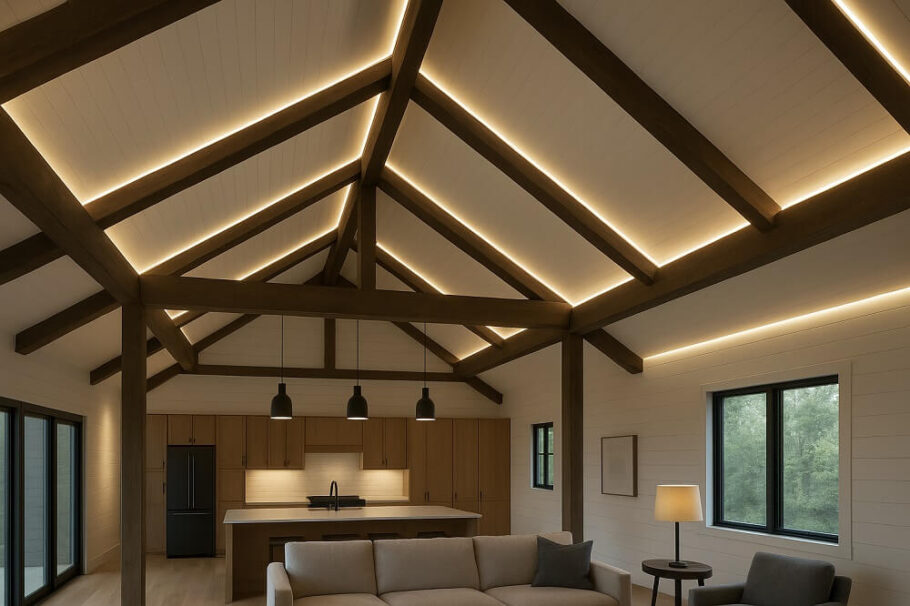
In an open ceiling, the beams are already exposed. You can clean them up, paint them, or simply clear-coat them to protect the steel while keeping the industrial look. Consider running LED strip lights along the bottom flange of the beam to create a floating effect. At night, this indirect lighting highlights the architecture of the roof without blinding you with direct glare.
The Magic of Lighting Design
In a standard 8-foot ceiling, a single ceiling light fixture can illuminate the whole room. In a barndominium with 16- to 20-foot ceilings, that rule goes out the window.
You have to think in layers.
Ambient Lighting: This is your general light. In a high ceiling, you need powerful fixtures to push the light down to the floor. Large, oversized pendants or a massive chandelier can serve this purpose. Don’t be afraid to go big. A tiny light fixture in a huge space will look like a thimble on a football field.
Task Lighting: Because the ceiling is so high, you cannot rely on it to light your countertops or your reading chair. You will need floor lamps, under-cabinet lighting in the kitchen, and wall sconces placed at a normal height to perform specific tasks.
Accent Lighting: This is where you highlight the ceiling itself. Use spotlights to graze up a stone fireplace wall. Use rope light or strip light tucked behind beams to create a glow. If you have a metal ceiling, the light will bounce off the corrugations in interesting ways. Use accent lighting to draw attention to the unique texture you’ve created.
Ceiling Fans: Scaling Them Right
Here’s a mistake I see all the time: people buy a standard 52-inch residential ceiling fan for their barndominium. They install it, turn it on, and feel absolutely nothing. Why? Because the fan is too small to move the massive column of air in the room.
In a barndo, you need scale. Look for “big-ass fans” (that’s literally the brand name of one popular option) or industrial-style fans with blades that span 60 inches to 8 feet. These move air slowly but massively, creating a gentle breeze that doesn’t feel like a helicopter landing in your living room.
Placement is also critical. If you have a very long great room, you might need two fans to circulate air effectively. Position them over the main seating areas, not just in the geometric center of the room.
Practical Considerations: Insulation and Utilities
Let’s get down to the nuts and bolts. Whatever aesthetic you choose, you have to hide the guts of the house.
If you go with a flat ceiling, you have a plenum space (the attic) to run your ductwork, electrical wires, and plumbing vents. It’s clean and easy.
If you go with an open ceiling, everything is exposed. This requires a lot more planning. You can’t just run wires haphazardly; they will be visible for the life of the home. Conduit becomes a design element. You can use sleek metal conduit for an industrial look, or you can hide wires behind the flanges of the steel beams.
Ductwork is the hardest part. Large, round HVAC ducts look messy. Consider using ductless mini-split systems for heating and cooling. They hang on the wall or sit on the floor, eliminating the need for overhead ducts entirely. Alternatively, you can build soffits or use the space between purlins to run ducts, though this is tricky.
Mixing Materials for a Curated Look
The most beautiful barndominium ceilings I’ve seen rarely use just one material. They mix and match to define different zones within the open floor plan.
For example:
- In the kitchen, you might have a flat drywall ceiling at a standard height (say, 10 feet) to create a sense of intimacy over the island. You can hang pendant lights here.
- As you move into the living room, the ceiling soars up to the roof peak, finished with white-washed shiplap.
- A massive steel beam wrapped in reclaimed walnut marks the transition between the two spaces.
This combination of low and high, smooth and textured, keeps the eye moving and makes the space feel dynamic rather than cavernous.
Conclusion
Designing a barndominium ceiling is not about picking a color and moving on. It is about shaping the very soul of your home. It requires you to balance the romance of open, industrial space with the practical realities of acoustics, heating bills, and maintenance.
Start by deciding how you want to feel. Do you want the rugged, adventurous feel of exposed steel and conduit? Do you want the cozy, cabin-like warmth of tongue-and-groove pine? Or do you want the sleek, seamless sophistication of drywall?
Once you know the feeling, the materials will follow. Take your time, look at photos, and visit other barndos if you can. This is one design decision where going big—and going bold—almost always pays off. After all, in a barndominium, the sky is quite literally the limit.