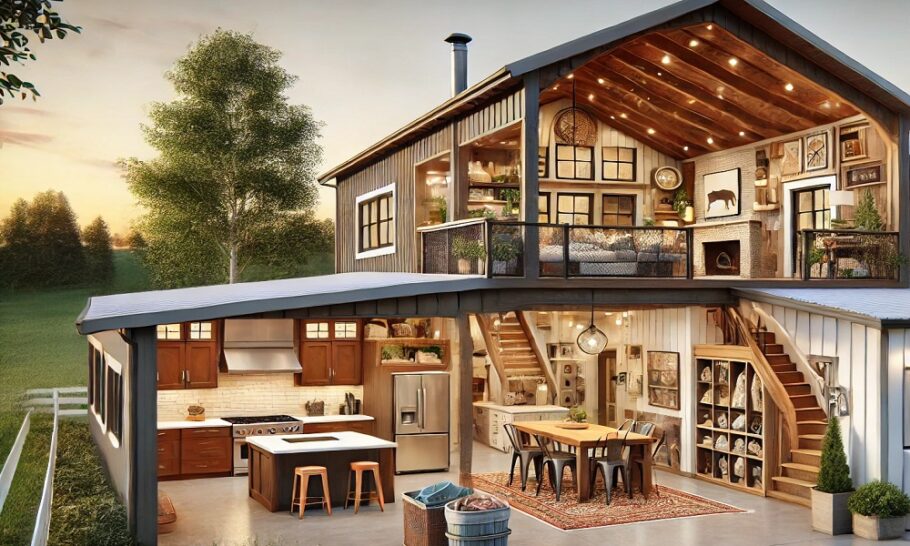
If you’ve spent any time scrolling through home design blogs or real estate listings over the past five years, you’ve likely noticed the meteoric rise of the barndominium. What started as a niche trend—converting old agricultural barns into rustic living spaces—has evolved into a full-blown architectural movement. We’ve all seen the sprawling, single-family barndos sitting on twenty acres of Texas prairie, complete with a stained concrete floor and a wall of glass overlooking the stock pond.
But the market is shifting again. We are now witnessing the next logical evolution of this trend: the “Barndo-minium.”
Forget the isolated homestead. The newest wave of development is taking the core principles of barndominium living—open concept steel buildings, low-maintenance materials, and industrial-chic aesthetics—and stacking them together. Across the Sun Belt and into the Midwest, developers and landowners are erecting multi-family barndominium communities. These are not your grandfather’s farm sheds, and they certainly aren’t your typical apartment complexes. They represent a unique hybrid of rural charm and suburban density, and they are changing the way we think about community living.
What exactly is a Multi-Family Barndominium?
To understand the “barndo-minium,” you first have to understand the appeal of its single-family parent. A traditional barndominium is a metal building (typically a rigid steel frame) that has been partitioned to include living quarters. The exterior screams “barn,” but the interior can look like a high-end loft.
Now, scale that concept up, or rather, replicate it. A multi-family barndominium community usually consists of several long, gable-roofed metal buildings situated on a shared parcel of land. Each building is subdivided into individual, private units. These units might be duplex-style (side-by-side), or they might be condos stacked on top of one another, accessible by exterior walkways that resemble the catwalks of an old industrial warehouse.
The aesthetic is consistent: corrugated metal siding, exposed structural beams, massive windows, and large roll-up doors that serve as walls to the outdoors. The community aspect comes into play with the land between the structures, which often includes shared amenities like fire pits, community gardens, dog parks, or even a central “farmhouse” style clubhouse.
The “Why Now?” Factor
Why are these communities popping up now? The answer lies at the intersection of the housing crisis, the remote work revolution, and a deep-seated cultural craving for authenticity.
- The Affordability Gap
Let’s be honest: building a custom barndominium on a large plot of land is still expensive. Land prices, even in rural areas, have skyrocketed. For many young families or downsizers, the dream of owning a five-acre homestead is financially out of reach. Multi-family barndominium communities offer an entry point. By sharing the land cost among multiple owners, developers can offer units at a price point significantly lower than a single-family detached home. It’s a way to buy into the lifestyle without buying the ranch.
- Low Maintenance, High Durability
The materials used in barndominiums—steel, concrete, and glass—are incredibly durable and require far less maintenance than traditional stick-built homes. There’s no siding to paint, no roof shingles to replace every twenty years, and no termites munching on the studs. For the demographic that typically flocks to condos (empty-nesters and first-time buyers), this “set it and forget it” durability is a massive selling point. In a shared community, where an HOA is likely managing the exteriors, having structures that can withstand hail, fire, and rot is a financial no-brainer.
- The “Agri-tourism” Aesthetic
We live in an era where people pay a premium for the “rustic experience.” We want our vacations to look like a Chip and Joanna Gaines fixer-upper, and now we want our permanent addresses to feel the same way. These communities tap into the agri-tourism aesthetic without the grueling work of actual farming. You get the view of the hayfield and the look of the barn, but your actual labor is limited to tending the potted plants on your private patio. It’s the ultimate expression of “farmhouse chic” applied to density.
The Architecture of Community
Designing a multi-family barndominium community requires a different mindset than designing a standard apartment complex. Standard apartments are often designed around maximizing unit count; barndo-miniums are designed around maximizing the interplay between the industrial shell and the natural environment.
One of the most innovative features in these communities is the use of the “party barn” concept. Because the units themselves are often compact—efficiently laid out in the open-floor-plan style that barndos are known for—the social life of the community moves outside. Developers are learning that the common areas need to be extraordinary. Imagine a central barn that houses a commercial kitchen, a gathering space with a two-story stone fireplace, and a long communal table made from reclaimed wood. It blurs the line between private residence and resort.
Furthermore, the construction method allows for unique unit features that are impossible in traditional wood-frame apartments. The clear-span steel structure means interior load-bearing walls are unnecessary. This allows for floor plans that can be reconfigured easily. A first-floor unit might have a 12-foot tall roll-up glass door that opens the entire living room to a private courtyard. An upper unit might feature a covered porch built into the roofline, accessed via the industrial catwalk. The flexibility of the steel frame gives architects the freedom to create units that feel custom, even in a multi-unit setting.
Who Is Moving In?
The resident profile for these communities is surprisingly diverse, but they all share a common desire: they want to opt out of the traditional housing market without giving up a sense of belonging.
- The Remote Worker: The tech worker who fled the city during the pandemic doesn’t want to live in a suburban vinyl village. They want high-speed internet (a non-negotiable for these developments) and a space that feels unique. They love the high ceilings and the loft-style vibe that reminds them of a Brooklyn warehouse, but they want it with a view of the sunset over a wheat field.
- The Multi-Generational Family: Barndominiums lend themselves well to multi-generational living, and the “barndo-minium” community can facilitate this on a larger scale. Grandparents might buy a single-story unit with no stairs, while their children buy a larger two-story unit in the next building over. They have their own space and privacy, but they are part of the same neighborhood.
- The Hobbyist: Remember that massive roll-up door? For the hobbyist, this is paradise. Whether it’s a classic car, a boat, a woodworking shop, or a collection of motorcycles, the ability to park or work inside your living space is a luxury. In a standard condo, you have a remote garage down the street. In a barndo-minium, your living room flows into your workshop.
The Challenges and Criticisms
Of course, this trend isn’t without its hurdles. Zoning remains the biggest obstacle. Most counties have strict separations between agricultural zones and residential zones. Convincing a planning commission to allow a multi-family development that looks like an agricultural building but functions as a high-density subdivision takes a lot of community outreach and legal work.
There is also the issue of financing. While single-family barndominiums have become easier to finance as lenders have become educated on the product, condos in metal buildings are still a gray area. Appraisers struggle to find comps, and traditional mortgage lenders can be skittish about “non-conventional” construction.
And then there is the aesthetic criticism. Detractors argue that these communities are just another form of suburban sprawl dressed up in rustic clothing. They worry that we are paving over paradise to put up faux-farmhouses, creating a Disney-fied version of rural life that lacks the soul of a real farming community. It is a valid point. The success of these communities depends on whether they integrate into the landscape or simply impose a theme upon it.
Looking Toward the Horizon
Despite the challenges, the momentum is undeniable. We are seeing the first wave of these communities sell out before the concrete is even poured. In states like Texas, Missouri, and Colorado, “agri-hoods” (agricultural neighborhoods) are becoming a legitimate asset class for real estate developers.
The “barndo-minium” represents a compromise we rarely see in American housing. It compromises between the desire for rural space and the financial reality of land costs. It compromises between the need for community connection and the desire for private, fortress-like homes. It takes the industrial efficiency of the steel building and softens it with the communal warmth of a village green.
As we move forward, expect to see these communities become more sophisticated. We will likely see the integration of more sustainable features—solar panels on those massive metal roofs are a natural fit, and rainwater catchment systems can easily be hidden in the industrial design.
The barndominium proved that we could live in a metal box and love it. The barndo-minium is proving that we can do it together. It may look like a barn from the highway, but for the people living inside, it looks a lot like home.