
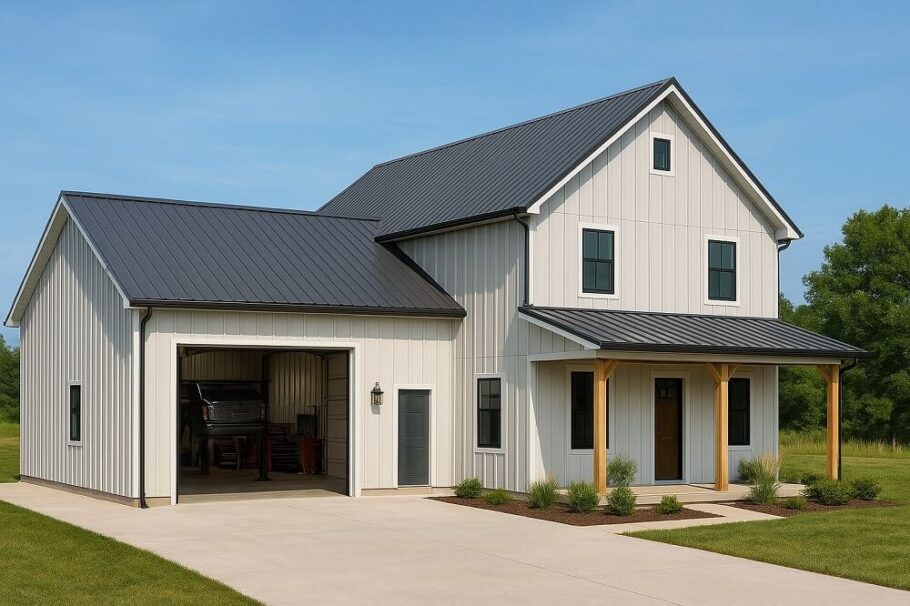
There’s a reason why the trend of converting metal buildings into living spaces—affectionately known as barndominiums—has exploded in popularity. The open-concept layouts, the soaring ceilings, and the industrial-chic aesthetic offer a blank canvas that traditional stick-built homes often can’t match. You get the durability of a steel structure with the warmth of a custom home.
However, if you own one—or are planning to build one—there is a silent enemy lurking in the shadows that doesn’t care about your beautiful floor plan or your stylish fixtures: moisture.
If you’ve ever woken up on a cool morning to find your windows dripping wet or noticed a musty smell in a corner of your great room, you’ve encountered the unique challenge of the metal building envelope. Because barndominiums are typically made of steel siding and roofing, they react to temperature changes much faster than wood-frame houses. When warm, humid indoor air hits a cold metal surface, it condenses into water. Left unchecked, that water leads to mold, rot in any wooden framing, corrosion of the metal, and a host of health issues .
The good news? This is entirely preventable. It just requires a shift in how we think about air. You can’t rely on a barndominium to “breathe” on its own the way an old farmhouse might. You have to engineer the breath. Here is a deep dive into the proper airflow strategies to keep your barndominium dry, healthy, and structurally sound.
Understanding the Perfect Storm
Before we start cutting vents and installing fans, it’s important to understand why these structures are so prone to “sweating.” In a traditional wood-frame home, the building materials themselves act as a buffer. Wood can absorb and release moisture gradually without immediate damage.
Metal doesn’t have that courtesy . It is a thermal conductor. When the temperature drops overnight, your metal roof and siding can become incredibly cold. Inside, you’re cooking dinner, taking showers, and breathing—all activities that pump warm, moisture-laden air into the environment. When that air meets the cold metal behind your walls or above your ceiling, it instantly cools down and releases that moisture. It’s exactly like a cold glass of lemonade on a summer day; the glass isn’t leaking, the water is coming from the air .
The problem is compounded by the fact that modern barndominiums are built tight. We use spray foam and sealed panels to be energy-efficient, which is great—until we realize we’ve sealed all that moisture inside with nowhere to go .
The First Line of Defense: The Building Envelope
Airflow isn’t just about moving air around the room; it starts with controlling air within the walls. You can have the best ceiling fans in the world, but if your wall cavities are condensing water, you’re fighting a losing battle.
- The Importance of a Thermal Break
You cannot let interior finishes touch exterior metal directly. This is a cardinal rule. If your drywall or insulation is sitting flush against the steel siding, that cold will transfer straight through. The goal is to create a thermal break.
Closed-cell spray foam is often the gold standard here . When applied directly to the interior side of the metal siding, it serves two purposes: it provides a high R-value, and it acts as an air seal and vapor barrier. Because it adheres to the metal, it stops the flow of humid air from reaching that cold condensing surface. If you’re using rigid foam boards, they must be continuous and meticulously taped to prevent air leaks .
- Addressing Thermal Bridging
Your barndominium likely has a steel frame—red iron beams or steel girts. These are massive thermal bridges. They conduct cold from the outside directly to the inside. If you just put fiberglass batts between them, the steel itself will sweat.
To prevent this, you need to cover the steel with insulation. This is where continuous insulation—like rigid foam board placed over the girts but under the metal siding—becomes critical . By wrapping the entire structure in a blanket of insulation, you keep the steel closer to indoor temperatures, eliminating the temperature difference that causes condensation.
Harnessing Natural Ventilation: Working with Nature
Once the building envelope is sorted, we need to manage the air inside the living space. Nature provides two free mechanisms for moving air: wind (cross-ventilation) and the stack effect (hot air rises). Your floor plan and window placement should exploit both .
- Cross-Ventilation
If you’re still in the design phase, look at the prevailing wind direction for your property. You want to place operable windows on opposite sides of the building. When the wind blows, it should be able to enter one side and exit the other, creating a “scrubbing” action that pushes stale, humid air out .
Casement windows are superior here because they can catch the wind and funnel it inside, unlike sliding windows which only open halfway.
- The Stack Effect
Remember that high ceiling you love? If it’s sealed tight at the top, it’s just a trap for hot, humid air. You need to let that heat escape. High clerestory windows, gable vents, or even an operable cupola allow the warm, moisture-laden air to rise out of your living space . This creates negative pressure at the bottom of the house, drawing cooler, drier air in through lower windows. It’s the same principle that keeps a termite mound perfectly climate-controlled .
Mechanical Ventilation: Taking Control
Natural ventilation is great, but it isn’t always available. You can’t open a window when it’s 20 degrees outside or pouring rain. This is where mechanical systems take over.
- The Workhorses: Spot Exhaust Fans
It seems simple, but it’s the most commonly violated rule: Exhaust fans must vent to the outside, not into the attic or a crawl space .
Your bathrooms, kitchen, and laundry room are the primary sources of humidity in your home. In a standard home, a little bit of moisture migration might be okay. In a sealed metal building, it’s a disaster.
- Bathrooms: Install fans with humidity sensors so they run until the moisture is cleared, not just on a 5-minute timer.
- Kitchen: Your range hood should be powerful and vented outside. Recirculating hoods that just blow air through a charcoal filter and back into the room do nothing for humidity control.
- Whole-Home Ventilation: ERVs and HRVs
Because barndominiums are built so tightly, they need controlled fresh air. You can’t rely on leaks around windows anymore. This is where an Energy Recovery Ventilator (ERV) or Heat Recovery Ventilator (HRV) becomes a game-changer .
An ERV is particularly effective in humid climates. It brings in fresh outdoor air and exhausts stale indoor air. But crucially, it transfers the humidity (and temperature) between the two airstreams. In the summer, it removes moisture from the incoming air before it enters your home, reducing the load on your air conditioner. In the winter, it traps indoor humidity and keeps it from being wasted outside. It’s the lungs your airtight barndominium needs.
The Power of Air Movement: HVLS Fans
You can have perfect humidity levels, but if the air is stagnant, you’ll still get cold spots, and cold spots lead to condensation. This is where the open-concept nature of a barndominium actually helps us—we have the space to use big tools.
- Destratification
In a building with 16 to 20-foot ceilings, the air temperature at the ceiling can be 10 to 15 degrees warmer than the air at the floor . This is called stratification. That warm air up there is holding moisture.
High Volume, Low Speed (HVLS) fans—those big, airplane propeller-style fans you see in gyms and barns—are the perfect solution. They move a massive column of air gently down to the floor. In the winter, you run them at a low speed in reverse (clockwise) to push that warm, trapped air down the walls and into the living space without creating a wind chill. This keeps the wall surfaces warm, preventing condensation .
- Enhancing Comfort
In the summer, the wind chill effect of an HVLS fan can make the space feel 5 to 10 degrees cooler, allowing you to set your thermostat higher and save on air conditioning costs . This constant gentle mixing ensures there are no “dead spots” in the house where air sits still long enough to let mold spores settle and grow.
Controlling the Source: Interior Humidity Management
Sometimes, the problem isn’t the structure; it’s us. A family of four can put several gallons of water into the air every day just through breathing, cooking, and showering .
- Dehumidification
Your air conditioner does dehumidify, but it’s a secondary function. On mild days when the AC doesn’t run much, humidity can spike. A whole-house dehumidifier integrated into your HVAC system is a wise investment . It runs independently of the cooling system to keep relative humidity consistently between 40% and 50%. This is the sweet spot where mold cannot thrive and condensation is unlikely. - Slab and Foundation Control
If your barndominium is on a concrete slab, moisture can wick up from the ground through capillary action. Before you ever pour concrete, you should lay down a thick vapor barrier (6 to 15 mil polyethylene) under the slab . If you have a crawl space, it needs to be encapsulated and conditioned, not left open to the humid outdoor air.
Maintenance: The Long Game
Preventing condensation isn’t a “set it and forget it” task. It requires a bit of vigilance.
- Check your filters: Dirty HVAC filters restrict airflow. If air isn’t moving across the cooling coils or through the ducts, it isn’t being dehumidified. Change them regularly .
- Inspect seals: Walk around your barndominium annually and check the caulking and seals around windows, doors, and where utilities enter the building. A small gap can let a surprising amount of humid air into a wall cavity .
- Monitor: Keep a digital hygrometer in your main living area. If you see the humidity consistently creeping above 55%, it’s time to check your ventilation systems and dehumidifier settings .
Conclusion
Living in a barndominium offers a freedom and aesthetic that is hard to replicate. But these structures demand respect for the laws of building science. You cannot treat them like a traditional wood-frame home and hope for the best.
By combining a robust, thermally broken insulation system with smart natural ventilation design and backing it up with mechanical systems like ERVs and HVLS fans, you can eliminate the condensation cycle. You’ll protect your investment from corrosion and mold, and you’ll create an indoor environment that is comfortable, healthy, and dry—no matter what the weather is doing outside.