
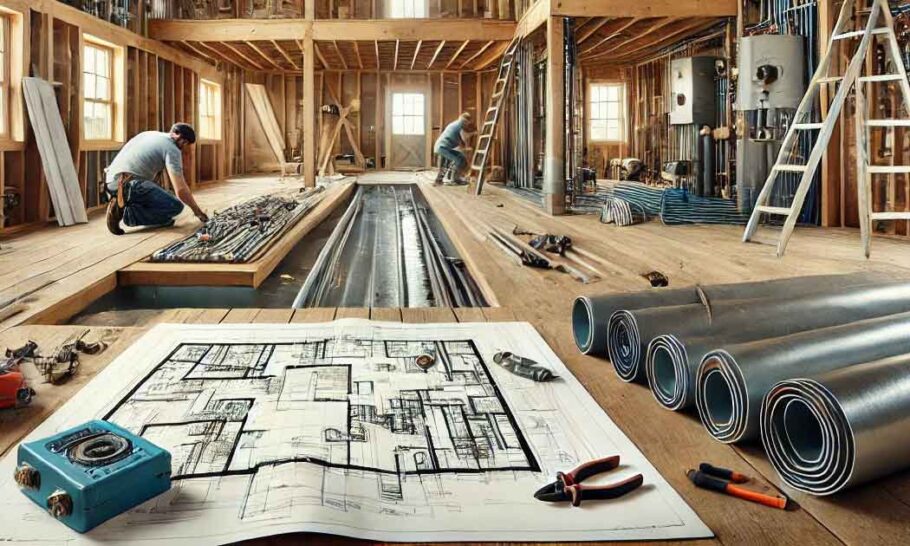
There’s no denying the allure of the barndominum. With their open-concept layouts, high ceilings, and the promise of a simpler, more efficient build, these steel-and-concrete structures have captured the imagination of homeowners looking to escape the mundane. The aesthetic is rugged, clean, and endlessly customizable. But if you’re in the planning stages of a barndo, I need to pull you aside for a moment. Let’s talk about what’s behind the walls.
Or rather, what’s in the concrete.
Having consulted on dozens of these builds, I can tell you that the single biggest source of stress for new barndominium owners isn’t the roofing or the insulation—it’s the plumbing. You’re essentially taking the complex circulatory system of a traditional home and injecting it into a building designed to be a wide-open pole barn. And that transition requires some serious forethought.
Here are the critical plumbing challenges you need to navigate to avoid turning your dream home into a watery nightmare.
1. The Slab Foundation: There’s No “Do-Overs”
Most barndominiums are built on a monolithic concrete slab. Unlike a traditional home with a basement or a crawlspace that offers access to pipes, your plumbing rough-in is a one-shot deal. Once that concrete is poured, the pipes are entombed forever.
In a standard wood-framed house, if a plumber glues a joint wrong or if a pipe shifts and cracks, you can cut a hole in the subfloor to fix it. In a barndo, you are looking at jackhammering concrete. That’s not just a repair; it’s a demolition event.
This means the rough-in stage is absolutely critical. You cannot rely on the “we’ll figure it out later” mentality. Every toilet flange, every shower drain, and every kitchen sink stub-out has to be placed perfectly before the trucks arrive.
The Expert Tip: I always recommend pressure testing the entire under-slab system before the pour. Fill the pipes with air or water and let them sit for 24 hours. Make sure there isn’t a pinhole leak or a loose fitting. It’s a few hours of work that can save you from a lifetime of regret.
2. The Venting Conundrum
Plumbing isn’t just about water flowing down; it’s about air flowing up. The plumbing code requires proper venting to allow sewer gases to escape and to let air into the drains so water can flow freely without sucking traps dry.
In a traditional two-story home, it’s relatively easy to run a 2-inch or 3-inch vent pipe up through the roof. But barndominiums often have complex roof structures with purlins and steel panels that you really don’t want to penetrate unnecessarily. Every hole in a metal roof is a potential leak.
Furthermore, because barndos often have massive, open great rooms, the bathrooms and kitchens might be clustered in the center of the slab, far away from an exterior wall. Getting that vent stack up through the roof in a straight line can be geometrically challenging.
The Solution: Many builders are turning to Air Admittance Valves (AAVs), also known as studor vents. These devices are installed under the sink or inside the wall and allow air to enter the system without needing a pipe through the roof. However, not all local codes accept them, and they have moving parts that can fail. If you use them, install them in accessible locations—don’t bury them in a sealed wall cavity.
3. Freezing Lines in the Attic and Exterior Walls
Here’s where the “barn” part of the barndominium fights the “domicile” part. Because the structure is often steel, the wall cavities might be shallower than standard 2×6 wood framing. This limits how much insulation you can pack in.
If your plumbing runs are in exterior walls—especially in the northern half of the country—you are asking for a burst pipe. The same goes for the attic. In a trussed roof design, it’s tempting to run water lines through the vented attic space to reach a wet bar on the other side of the room. If that attic isn’t perfectly conditioned (heated), a cold snap will turn your pipes into ice sculptures.
The Strategy: Keep all plumbing lines in the “thermal envelope” and in interior chases. If you can design the floor plan so all the bathrooms are back-to-back, sharing a common wall, you minimize the amount of piping that has to travel through cold zones. If lines must go in the attic, they need to be on the interior side of the insulation with heat trace tape—and you need a generator backup for when the power goes out.
4. Water Heater Location and Recirculation
Barndominiums are famous for their long, linear layouts. You might have the master suite at one end and the laundry/guest rooms at the other.
If you place a standard tank water heater in a utility room in the middle, the water has to travel a long distance to reach the master shower. In a house with a slab foundation, that hot water pipe is buried in concrete. It acts as a massive heat sink. You could be running the shower for two minutes just waiting for hot water, wasting gallons of water down the drain while the slab steals all the heat from the pipe.
Modern Approaches:
- On-Demand Recirculation Pumps: These pumps create a loop that keeps hot water circulating near the fixture. While they use a bit of energy to run the pump, they save a massive amount of water.
- Point-of-Use Heaters: Instead of one big water heater, consider a small tankless unit under the bathroom sink or a dedicated unit for the master bath. This eliminates the wait time entirely.
- PEX Manifold Systems: Run 3/8-inch PEX lines directly from a central manifold to each fixture. This ensures dedicated lines with no junctions in the slab, and because the water volume is smaller, it arrives faster than waiting for a big 3/4-inch trunk line to purge.
5. The Well and Septic Reality
Most barndominiums are built in rural areas, which means you’re likely dealing with a well and a septic system, not municipal utilities. This adds two layers of complexity.
First, the well pressure. If you have long pipe runs inside the house and you’re relying on a standard 40/60 pressure switch, the pressure drop by the time water reaches the far shower might be pathetic. You need to calculate “pressure drop” based on the length of the run. You might need a booster pump or a constant pressure system (Variable Frequency Drive) to keep the water pressure acceptable.
Second, the septic tie-in. You have to exit the slab with the main waste line at a specific depth and slope. If your barndo is on a high foundation stem wall, you have to calculate how to drop that pipe down to meet the septic inlet without creating a “belly” in the line where solids can settle. And if you have a basement or a safe room under part of the barndo (which is becoming popular in tornado alley), you now need an upflush toilet or a sewage ejector pump—more mechanical parts that can fail.
6. Working with the Metal
Finally, let’s talk about the structure itself. In a wood-framed house, plumbers love to notch studs and drill big holes through joists. You can’t do that with steel.
Barndominium kits come with specific engineered steel framing. You cannot cut a 2-inch hole through a steel I-beam to run a drain line. It compromises the structural integrity. This means your plumbing chases have to be designed to go around the steel, or you need to build “soffits” (dropped ceilings) in bathrooms to hide the pipes that can’t go through the roof.
If you’re not careful, you end up with a beautiful, massive bedroom that has a random 12-inch deep box running across the ceiling because that’s the only way to get the vent stack to the outside.
The Bottom Line
Building a barndominium is a different beast than building a traditional house. The margin for error is thinner because the access is worse. The key to success isn’t just finding a plumber; it’s finding a plumber who has done a barndo before.
You need to plan the plumbing before you pour a single ounce of concrete. Map out the fixture locations. Think about the thermal dynamics. Decide on your venting strategy.
If you do it right, you’ll have a home that is as functional as it is beautiful. If you do it wrong, you’ll be the one with the jackhammer. Choose wisely.