
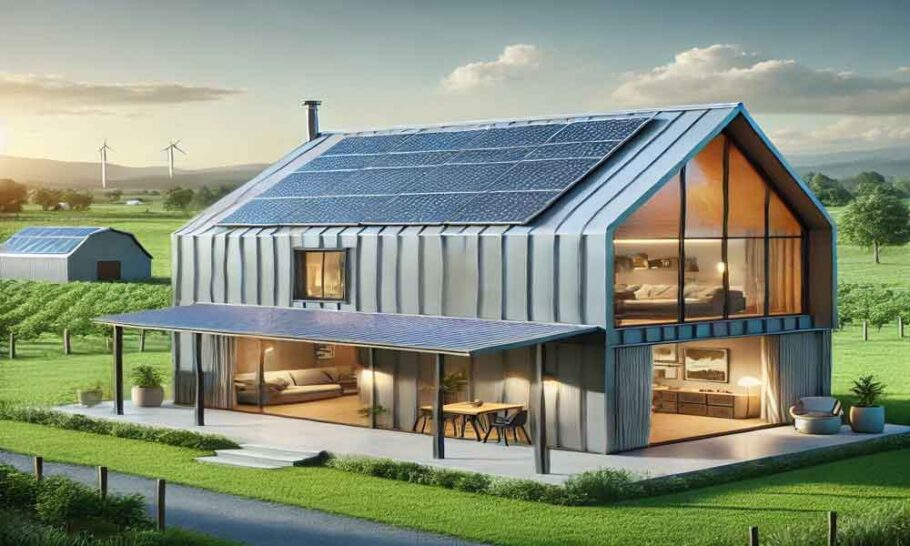
Walk onto any rural property these days, and you’re likely to see a trend that merges rustic living with modern aesthetics: the barndominium. These steel-clad structures have exploded in popularity, offering durability, open floor plans, and a blank slate for homeowners. But as someone who has spent the last decade engineering solar PV systems, I see something else when I look at a barndominium. I see the perfect host for a solar array.
While a standard residential solar install on an asphalt shingle roof is fairly straightforward by now, mounting solar panels on a barndominium presents a unique set of engineering challenges and opportunities. The structure is fundamentally different from a stick-framed house. It breathes differently, handles load differently, and the roof profile is rarely a simple gable.
If you are planning to build a ‘barndo’ or retrofit an existing one with solar, understanding the engineering behind the installation is critical to ensuring your investment doesn’t compromise the integrity of your home.
The Structural Reality of the Standing Seam Roof
The most common roofing system on a barndominium is the standing seam metal roof. From an engineering perspective, this is the gold standard for solar attachments. However, it requires a complete shift in thinking from the “drill and seal” mentality of traditional roofing.
When we mount panels on a composition shingle roof, we typically use flashings and lag bolts driven directly into the rafters. We are penetrating the waterproof membrane. On a standing seam roof, the goal is zero penetration.
Here is where the engineering gets interesting. Standing seam roofs are designed to expand and contract with temperature changes. The panels “float” on clips that allow the metal to slide back and forth. If you clamp a solar mounting system too rigidly to these seams, you risk buckling the metal or tearing the seams apart during thermal cycling.
We use specialized clamps that grab the seam itself. The engineering challenge lies in the sheer variety of seam profiles. There is no one-size-fits-all clamp. We have to verify the exact seam dimensions—height, width, and the shape of the crimp—to ensure the clamp has sufficient bite force without deforming the seam. The load calculations here are intense. We have to account for wind uplift (which is massive on a smooth metal roof) and ensure the clamp’s resistance to pull-out exceeds the potential force of a 100 mph gust by a safety factor of three or more.
Dealing with Wide-Span Structures and Purlin Spacing
Here is the engineering hurdle that trips up a lot of installers who are used to residential work. A typical house has rafters spaced 16 or 24 inches apart. A barndominium, however, is essentially a pre-engineered steel building. The roof is supported by purlins (horizontal beams) that span between the main frames. These purlins are often spaced five, six, or even eight feet apart.
When we mount solar panels, we usually attach the rails to the roof. The rails need support wherever they cross a purlin. With standard residential spacing, we can hit a structural member every two feet. With barndominium spacing, you might have a rail spanning six feet with zero support in the middle.
This changes physics completely.
We have to look at the thickness of the sheet metal. Thin-gauge steel that spans six feet is designed to hold snow load, but it is not designed to have a point load pulling upward on it in the middle of the span. If we simply clamp in the middle of a purlin bay and pull upward (wind lift), we risk “oil-canning” the roof—permanently deforming the flat pan of the metal.
To solve this, we often have to specify additional structural support. Sometimes this means running “hat channel” or “Z-purlin” sections perpendicularly across the roof to break up those long spans before we even start installing solar rails. We are essentially creating a sub-frame that transfers the solar load back to the primary steel frames, bypassing the thin skin of the roof entirely.
The Grounding Imperative
If there is one area where barndominium solar engineering diverges from residential, it is in electrical grounding. A wood-framed house is naturally insulating. A barndominium is a massive steel cage. It is also a massive conductor.
When you introduce a DC electrical system (solar panels) onto a steel building, you must be obsessive about grounding and bonding. Lightning protection becomes a more significant conversation. We aren’t just grounding the panels; we have to ensure the entire building is at the same electrical potential to prevent arcing.
The standing seam clamps we use often have built-in grounding points that bite through the protective coating of the metal roof to establish a bond. We then have to bond the array to the steel structure of the building. This is not simply a matter of code compliance; it is a safety imperative. A floating ground on a metal building can create a serious shock hazard or become an ignition source in the event of a fault.
The Electrical Service and “The Shop” Factor
Barndominiums usually have different electrical demands than a standard home. Beyond the living quarters, there is often a “shop” portion of the building. This means heavy machinery, welders, compressors, and electric vehicle charging for the trucks and toys.
From an engineering standpoint, this changes the load profile drastically. A standard 200-amp service is often insufficient. We see many 400-amp or even 800-amp services in these buildings.
When designing the solar interconnection, we have to decide where on that service to tie in. The Point of Common Coupling (PCC) must be chosen carefully. If the solar feeds into the main panel but the heavy machinery is on a sub-panel, we have to account for the voltage drop and the potential for the solar to back-feed through the system.
Furthermore, the “shop” load offers a unique opportunity. Barndominium owners are often able to offset a much higher percentage of their usage because their daytime loads (running tools) coincide with peak solar production. This is where we might look at power optimizers or microinverters to ensure that shading from a large silo or grain bin doesn’t cripple production for the whole array.
Accounting for Thermal Dynamics
We touched on thermal expansion with the seams, but there is a larger thermal picture to consider. A barndominium is essentially a giant radiator. In the summer, the metal roof gets incredibly hot—much hotter than asphalt shingles. This ambient heat reduces the efficiency of solar panels. Every degree above Standard Test Conditions (25°C or 77°F) reduces voltage.
Good engineering here involves ensuring an air gap between the roof and the panels. We use standoffs that lift the panels high enough off the roof surface to allow wind to flow underneath, cooling the panels passively. This isn’t just about efficiency; it is about longevity. Excess heat degrades panel components faster. By designing the mounting system to promote airflow, we protect the long-term return on investment.
Conclusion: Respect the Structure
The beauty of a barndominium is that it is an engineered structure from the ground up. The steel framing is designed to handle specific loads in specific ways. The worst thing you can do is treat a solar installation as an afterthought—simply bolting equipment on without considering how it interacts with the building’s engineering.
When done correctly, a barndominium solar installation is a work of precision. It respects the thermal movement of the steel, distributes loads back to the primary framing, and integrates safely with the electrical system.
For the homeowner, this means a system that will outlast the panels themselves, surviving wind, snow, and time without a single leak. For us engineers, it is a rewarding challenge that proves renewable energy can adapt to any architecture, no matter how unconventional.