
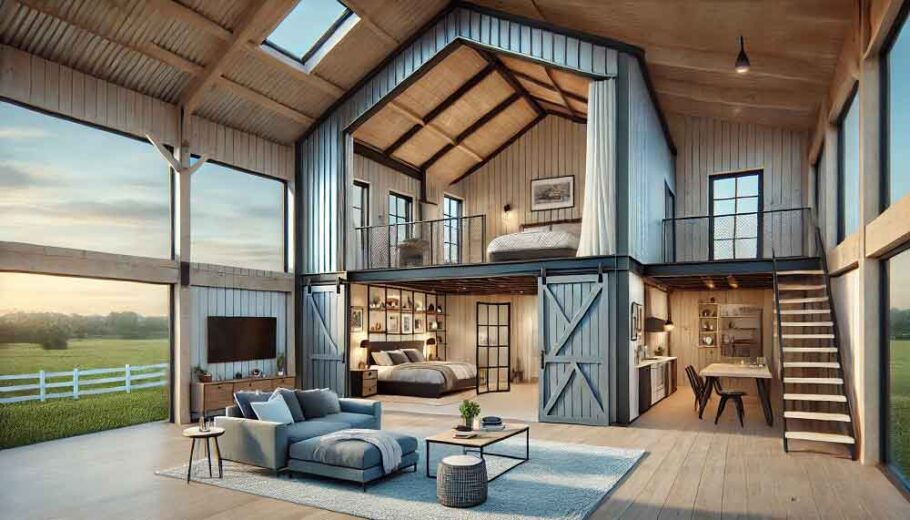
The way we work has changed. More entrepreneurs are building income from home—whether it’s welding, design services, e-commerce, content creation, automotive repair, or professional consulting. As property prices climb and commercial rents become harder to justify, many business owners are asking a practical question:
Why not build a space that serves both home and business under one roof?
That’s where a barndominium shines.
Originally inspired by barn-style metal structures, a barndominium blends residential comfort with workshop-scale functionality. High ceilings, wide-open spans, strong steel frames, and flexible layouts make it uniquely suited for home-based businesses. Unlike a traditional house retrofitted into an office, a barndominium can be engineered from day one to support both living and working.
If you’re considering building a barndominium for your home business, here’s what you need to know—beyond the Pinterest boards and glossy photos.
Why a Barndominium Makes Sense for Entrepreneurs
A barndominium offers structural advantages that traditional stick-built homes struggle to match.
First, the open-span design allows you to create large uninterrupted work areas. Whether you need a fabrication shop, product storage, or a photography studio, steel frames eliminate the need for load-bearing interior walls. You get freedom in layout.
Second, ceiling height. Many barndominiums feature 12- to 20-foot ceilings. That means vehicle lifts, tall shelving, industrial lighting rigs, or mezzanine offices are all realistic options.
Third, durability. Metal structures handle heavy use better than standard residential construction. For businesses that involve equipment, materials, or machinery, that matters.
Finally, cost efficiency. In many areas, building a combined residential and commercial structure can cost less than purchasing a home plus leasing separate commercial space. Long term, you reduce overhead dramatically.
But building a barndominium for a business isn’t just about adding a big shop to a house. It requires intentional planning.
Start With Zoning and Legal Reality
Before sketching floor plans, check your local zoning regulations.
Some residential zones restrict certain business types. You may need:
- Conditional use permits
- Parking accommodations
- Noise limitations
- Separate entrances
- Fire-rated separations
If clients or customers will visit your property, zoning becomes even more important.
If your business involves heavy equipment, chemicals, welding, or food production, additional regulations may apply. Don’t assume rural land means “anything goes.” Verify first. It’s far cheaper to adjust plans early than to fight compliance issues after construction.
Separate Work From Living — Even If It’s Under One Roof
One of the biggest mistakes home-based entrepreneurs make is blending work and home too tightly.
Yes, a barndominium allows integration—but psychological and practical separation is crucial.
Design considerations:
- Separate entrances for business and residential areas
- Dedicated parking for clients or deliveries
- Soundproofing between shop and living space
- Fire-rated walls where required
- Clear circulation paths that don’t run through your kitchen
This separation protects both professionalism and personal life. You don’t want clients walking past laundry baskets. And you don’t want business noise invading family dinners.
Think of it as two environments sharing a structure—but functioning independently.
Designing for Specific Business Types
Different businesses demand different layouts. Here’s how a barndominium adapts.
Workshop-Based Businesses
For welders, mechanics, woodworkers, and fabricators, the workshop often occupies 40–60% of the total footprint.
Key design elements:
- Reinforced concrete slab with appropriate thickness
- Floor drains if needed
- High bay doors for vehicle or equipment access
- Ample electrical capacity (3-phase if required)
- Proper ventilation systems
- Insulated walls and roof to manage temperature
Steel framing handles sparks, heat, and vibration far better than traditional wood framing.
Office or Consulting Businesses
If your business is consulting, accounting, design, or tech-based, your priorities shift.
Important considerations:
- Sound insulation for video calls
- Dedicated fiber internet access
- Natural lighting balanced with glare control
- Client-facing office space separate from living area
- Professional bathroom access for visitors
You may not need massive square footage—but thoughtful acoustic and lighting design makes all the difference.
E-Commerce and Storage-Based Businesses
Online sellers need clean, organized storage and shipping areas.
Consider:
- Climate-controlled storage
- Shelving that reaches ceiling height
- Dedicated packing station
- Receiving area with double doors
- Clear separation between inventory and household goods
The tall ceilings in a barndominium allow vertical storage that maximizes footprint efficiency.
Creative Studios
Photographers, content creators, and artists benefit from open layouts.
Design ideas:
- North-facing windows for consistent light
- Blackout options for full lighting control
- Seamless floors and backdrops
- Dedicated editing suite
- Sound-treated walls
The industrial aesthetic of exposed steel can even become part of your brand identity.
Structural Engineering Matters More Than You Think
A barndominium built for business is not the same as a simple rural residence.
Load requirements change when:
- You install heavy machinery
- You store large inventory
- You add mezzanine office spaces
- You incorporate vehicle lifts
Slab thickness, reinforcement patterns, and anchor systems must be designed accordingly. Cutting corners here leads to cracks, settlement, and expensive repairs later.
Electrical design is equally critical. Business-grade loads require larger panels, dedicated circuits, surge protection, and backup power planning.
If you anticipate growth, oversize your electrical service from day one. Upgrading later is disruptive and costly.
Insulation and Climate Control: Don’t Underestimate It
Metal buildings are incredibly strong—but they demand proper insulation strategy.
Without it, you’ll face:
- Condensation problems
- Heat buildup
- High energy bills
- Discomfort in work areas
Closed-cell spray foam, rigid board systems, or hybrid insulation approaches work well in barndominiums. Climate control should be zoned separately for living and work areas. You don’t want to cool a 2,000-square-foot workshop at midnight when only the bedroom needs air conditioning.
Ventilation is especially important for welding, painting, woodworking, or automotive work. Design airflow intentionally. Don’t rely on open doors.
Branding Through Architecture
A barndominium doesn’t have to look like a barn.
Exterior finishes can include:
- Modern metal panels
- Stone accents
- Wood trim
- Glass storefront sections
- Covered porches
If clients visit your space, the building itself becomes part of your brand. A clean, modern façade signals professionalism. Thoughtful landscaping enhances credibility.
Interior finishes matter too. Even in workshop spaces, organized cable management, proper lighting, and clean surfaces communicate competence.
Financial Strategy: Build for Cash Flow, Not Just Comfort
When building a barndominium for business, think like an investor.
Ask:
- Will this reduce monthly overhead?
- Will this allow business expansion?
- Will it increase property value?
- Can parts of it generate rental income later?
Some entrepreneurs design their barndominium so the business area can later convert into rental space, additional living quarters, or separate office suites.
Flexibility protects your investment.
Construction costs vary by region, but combining business and residential space often reduces:
- Property duplication
- Utility duplication
- Insurance duplication
- Commute costs
Over a decade, those savings compound significantly.
Noise, Safety, and Liability
Home businesses introduce new risks.
If clients visit, you may need:
- Commercial liability insurance
- ADA-compliant access depending on jurisdiction
- Fire suppression systems
- Emergency lighting and exit signage
Even if not legally required, safety measures protect you from lawsuits.
Sound control deserves special attention. Insulated partitions, double drywall, resilient channels, and acoustic panels can dramatically reduce transmission between workshop and home.
If you operate loud equipment, your future self—and your family—will thank you.
Planning for Growth From Day One
Many home businesses outgrow their initial space quickly.
Design strategies that anticipate growth:
- Leave room for expansion on your property
- Pre-plan future door openings
- Stub out plumbing lines for later additions
- Oversize structural elements slightly
- Design rooflines that allow extensions
A barndominium’s modular nature makes expansion easier than traditional homes—if you plan ahead.
Work-Life Balance by Design
Working from home can blur boundaries. Architecture helps restore them.
Simple strategies:
- Separate daily routines for entering the business space
- Clear visual division between home and work
- Soundproofed office door
- Distinct lighting atmosphere in each zone
You should feel like you’re “going to work,” even if that’s 30 feet from your kitchen.
Intentional design prevents burnout.
Sustainability and Long-Term Value
Steel structures are durable and often require less maintenance than wood-framed buildings. Metal roofing can last decades. Energy-efficient insulation and solar panels reduce operating costs.
A well-designed barndominium built for business can serve multiple generations or transition between uses over time.
In uncertain economic climates, having control over both your workspace and residence is a strategic advantage.
Final Thoughts
Building a barndominium for a home business isn’t about chasing a trend. It’s about designing infrastructure that supports your livelihood.
When planned correctly, a barndominium offers:
- Structural strength
- Flexible layouts
- Reduced overhead
- Professional presentation
- Expansion potential
It allows entrepreneurs to stop renting space that builds someone else’s equity and start investing in their own.
But success depends on thoughtful planning—zoning compliance, structural engineering, insulation strategy, business separation, and future scalability.
Treat the project as both a home and a commercial facility. Design it with intention. Engineer it properly. Build it to support growth.
When your workspace and your home are aligned under one roof—designed for purpose, not compromise—you create more than a building.