
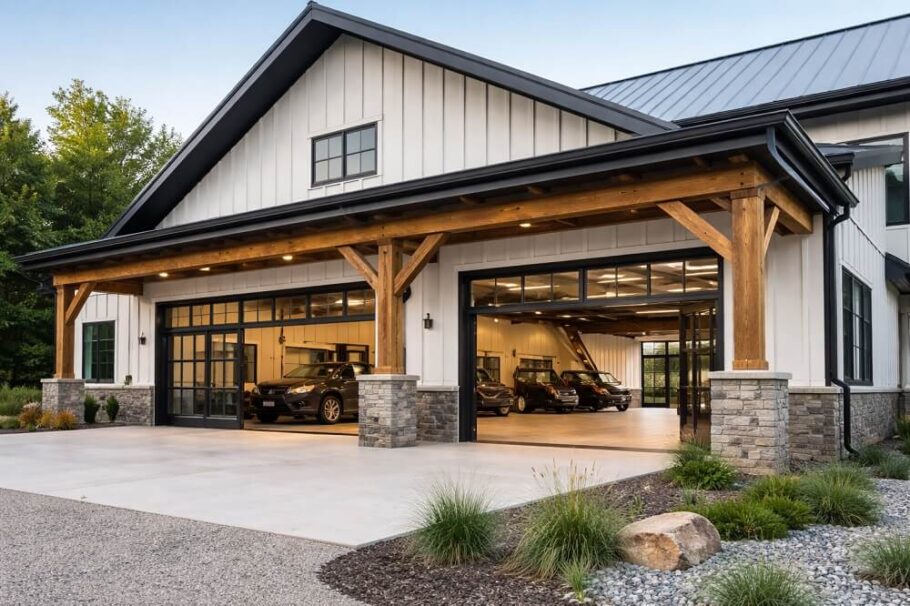
The split-level barndominium is a smart hybrid of classic split-level home planning and modern barndominium construction. Instead of stacking all living spaces on full floors, a split-level barndominium staggers them vertically—typically by half-levels—creating distinct zones that are connected by short stair runs. The result is a home that feels spacious, efficient, and architecturally interesting without the cost or complexity of a full multi-story build.
In a world where barndominiums are prized for flexibility, durability, and cost control, the split-level approach adds another layer of value. It allows owners to adapt the structure to sloped land, separate noisy and quiet areas, and achieve a larger “feel” within a modest footprint. Whether you’re building on a hillside, above a shop or garage, or simply want smarter circulation, the split-level barndominium is worth a close look.
The Core Concept Behind a Split-Level Design
At its heart, a split-level layout divides the home into zones that sit half a story apart rather than on one continuous plane. You might enter the home at a mid-level, go up a short flight of stairs to reach bedrooms, and go down a short flight to access living areas, workshops, or storage.
In a barndominium, this concept pairs naturally with steel framing and open spans. Because metal buildings can easily handle large, unobstructed spaces, designers have more freedom to step floors up or down without being constrained by traditional load-bearing walls. This makes split-levels especially appealing for barndominiums compared to conventional stick-built homes.
Why Split-Level Designs Work So Well for Barndominiums
Barndominiums are already known for efficient use of materials and space. The split-level approach enhances those strengths in several ways.
First, it maximizes usable square footage without increasing the building’s footprint. By stepping floors instead of expanding outward, owners can add functional areas while keeping foundation and roofing costs under control.
Second, split-levels are excellent for challenging sites. Sloped or uneven land often requires expensive grading for flat, single-level homes. A split-level barndominium can follow the natural contour of the land, reducing excavation and preserving drainage patterns.
Third, the design naturally creates zoning. Living rooms, kitchens, bedrooms, workshops, and offices can be separated vertically, which helps control noise, privacy, and even temperature differences.
Typical Layout Configurations
There’s no single “correct” way to design a split-level barndominium, but a few layouts are especially common.
Entry-Level Living
In this configuration, the main entrance opens into a central living space such as a kitchen or great room. A short staircase leads up to bedrooms and bathrooms, while another leads down to a garage, workshop, or recreational area. This is popular for families who want daily living spaces front and center, with quieter zones tucked away.
Garage or Shop Below Living Space
Many barndominium owners want large garages, shops, or storage areas. A split-level layout allows these spaces to sit partially below grade, with living areas raised above. This not only improves separation between work and home life but can also help with temperature control and sound isolation.
Hillside or Walk-Out Designs
On sloped land, a split-level barndominium can feature a lower level that opens directly to the outdoors on one side, while the upper level meets the grade on the opposite side. This “walk-out” approach is ideal for scenic sites and makes excellent use of views and natural light.
Structural Considerations in Split-Level Barndominiums
While split-level barndominiums offer design freedom, they also require thoughtful engineering. Floor elevations change, loads shift, and stair openings must be carefully integrated into the structure.
Steel framing systems are particularly well-suited for this. Long spans and high load capacity allow designers to create stepped floors without cluttering the interior with columns. Mezzanine-style framing is often used to support half-levels, especially when living areas sit above garages or shops.
Foundation design is another critical factor. Split-levels may require stepped footings or retaining walls, especially on sloped sites. Proper drainage and waterproofing are essential to prevent moisture issues where floors meet grade.
Interior Flow and Daily Living
One of the biggest questions people have about split-level homes is whether they feel awkward to live in. When designed well, the answer is no—quite the opposite.
Short stair runs tend to feel less intrusive than full staircases, and they naturally guide movement through the home. This creates a sense of progression and separation without long hallways or wasted space.
For families, split-levels can be a blessing. Kids’ bedrooms can be slightly removed from living areas, giving everyone more privacy. Home offices can be tucked into quieter zones, away from daily activity. Even pets benefit, as spaces like mudrooms or utility areas are easy to isolate.
Energy Efficiency and Climate Performance
Split-level barndominiums can also perform well from an energy standpoint. By partially embedding lower levels into the ground, the structure can take advantage of earth-sheltering effects, which help stabilize indoor temperatures.
Zoning becomes easier, too. Heating and cooling systems can be designed to serve different levels independently, reducing energy use during off-hours. High ceilings in living areas can be paired with lower ceilings in bedrooms or utility spaces, optimizing comfort and airflow.
However, careful insulation detailing is crucial. Floor assemblies between levels must be well-sealed to prevent air leakage and sound transfer. With proper planning, a split-level barndominium can be just as efficient—or more so—than a single-story design.
Cost Implications: Is Split-Level More Expensive?
Cost is always a key consideration, and split-level barndominiums often surprise people in a good way. While there may be some added expense for stepped foundations and additional framing complexity, these costs are often offset elsewhere.
Smaller roof areas, reduced grading, and efficient use of volume can all help balance the budget. In many cases, a split-level design delivers more functional space per dollar than a sprawling single-level home.
That said, costs depend heavily on site conditions and design choices. Simple split-levels with modest elevation changes are typically very economical, while highly customized designs with dramatic level shifts may require a larger investment.
Aesthetic Appeal and Design Flexibility
From an architectural standpoint, split-level barndominiums offer a lot of creative freedom. Externally, they can appear compact and grounded, even when housing a substantial amount of interior space. Rooflines can step with the structure, adding visual interest without unnecessary complexity.
Inside, split-levels create natural focal points. Overlooks, partial walls, and open staircases add depth and character. These features work especially well with industrial, modern farmhouse, or rustic design styles commonly associated with barndominiums.
Who Should Consider a Split-Level Barndominium?
Split-level barndominiums are not for everyone, but they shine in certain situations.
They are ideal for owners with sloped or irregular land, those who want to integrate garages or workshops seamlessly, and families who value functional zoning. They also appeal to people who like architectural interest without the cost of a full two-story home.
However, accessibility should be considered. If aging in place or wheelchair access is a priority, additional planning—such as ramps, lifts, or strategic room placement—may be needed.
Final Thoughts
The split-level barndominium is a clever evolution of both split-level housing and barndominium design. By stepping floors instead of stacking them, it delivers efficient space planning, strong visual appeal, and adaptability to challenging sites. When paired with modern steel construction, the result is a home that feels open, purposeful, and uniquely tailored to its environment.
For anyone looking to build a barndominium that goes beyond the standard single-level layout—without jumping to the complexity of a full multi-story structure—the split-level approach offers a compelling middle ground. It’s practical, flexible, and, when done right, incredibly livable.