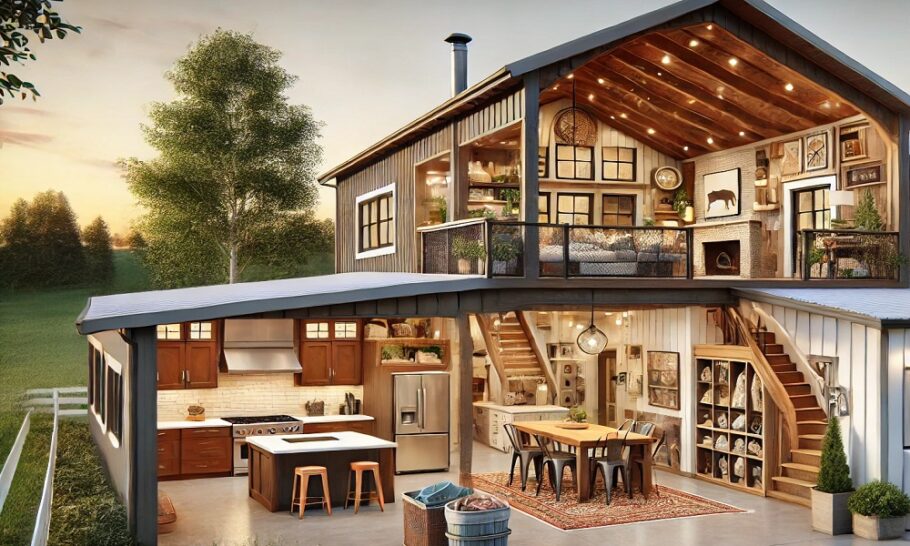
The barndominium has already proven itself as one of the most flexible and cost-effective building styles of the modern era. Combining the strength of post-frame or steel construction with residential comfort, barndominiums appeal to homeowners, developers, and investors alike. Now, a new evolution is gaining attention across rural, suburban, and even semi-urban landscapes: the modular barndominium cluster.
A modular barndominium cluster is not just a single structure, but a thoughtfully planned group of modular barndominium units arranged around shared infrastructure, outdoor spaces, or functional hubs. This approach blends modular construction efficiency with community-oriented design, offering scalability, adaptability, and long-term value that traditional single-building projects often lack.
In this article, we explore what modular barndominium clusters are, how they work, why they are gaining popularity, and how they can be designed for residential living, mixed-use development, or income-generating communities.
Understanding the Modular Barndominium Cluster Concept
At its core, a modular barndominium cluster consists of multiple prefabricated or semi-prefabricated barndominium units that are assembled on-site in a coordinated layout. Each module can serve a specific function, such as living space, workspace, guest housing, storage, or shared amenities.
Unlike traditional housing developments where every home is built independently from the ground up, modular clusters rely on repeatable building components. These components are manufactured off-site under controlled conditions, then transported and installed efficiently. The result is faster construction timelines, predictable costs, and consistent quality across all units.
What makes the cluster model unique is the intentional relationship between buildings. Instead of isolated structures, units are arranged to encourage interaction, shared resources, and flexible expansion.
Why Modular Construction Works So Well for Barndominiums
Barndominiums are already well-suited for modular construction due to their simple structural geometry and open interior layouts. Steel frames, post-frame systems, and standardized bay spacing all align naturally with modular design principles.
Modular construction allows wall panels, roof sections, floor systems, and even mechanical components to be produced in advance. When combined with barndominium construction methods, this approach offers several advantages:
First, construction speed increases dramatically. While site preparation and foundation work are underway, modules can be fabricated simultaneously. This parallel process can reduce overall build time by months.
Second, quality control improves. Factory-built components are protected from weather exposure and assembled using precise equipment, reducing the likelihood of structural errors or material defects.
Third, cost predictability becomes more reliable. With standardized modules, pricing is easier to estimate, minimizing surprises caused by labor shortages or material price fluctuations.
When these benefits are multiplied across multiple buildings in a cluster, the efficiency gains become even more significant.
Design Philosophy Behind Modular Barndominium Clusters
A successful modular barndominium cluster starts with a strong design philosophy. Rather than treating each building as a standalone project, the cluster is designed as a cohesive system.
One common approach is the hub-and-spoke layout. In this configuration, shared amenities such as a community hall, workshop, laundry facility, or co-working space are placed at the center. Residential or private modules radiate outward, creating a balance between privacy and connection.
Another popular layout is the courtyard model. Here, modules are arranged around a central open space that functions as a shared yard, garden, or gathering area. This layout promotes natural light, ventilation, and a strong sense of community.
Linear layouts are also effective, especially on narrow or elongated properties. Units are aligned along a central walkway or access road, allowing for phased expansion over time.
Regardless of the layout, modular clusters emphasize flexibility. Units can be added, removed, or reconfigured as needs change, making the development adaptable over decades.
Residential Living in Modular Barndominium Clusters
For homeowners, modular barndominium clusters offer a compelling alternative to traditional subdivisions. Instead of purchasing a single large home, residents can live in smaller, efficient units while sharing amenities that would otherwise be cost-prohibitive.
For example, a cluster might include individual living modules for each household, paired with shared spaces such as a large kitchen, fitness area, guest suites, or recreational rooms. This model reduces individual construction costs while enhancing overall lifestyle quality.
Clusters are particularly appealing for extended families. Parents, adult children, and grandparents can live in separate modules on the same property, maintaining independence while staying close. Over time, additional modules can be added to accommodate growing families or changing needs.
Privacy is maintained through thoughtful orientation, sound insulation, and landscaping. Even though units are part of a cluster, residents can enjoy quiet, personal spaces without feeling crowded.
Modular Barndominium Clusters for Co-Housing and Community Living
Co-housing communities are experiencing renewed interest, and modular barndominium clusters fit this model exceptionally well. These developments emphasize shared values, collaboration, and efficient use of resources.
In a co-housing cluster, residents may share gardens, workshops, childcare facilities, or renewable energy systems. Modular construction allows each unit to be customized to individual preferences while maintaining a unified architectural language.
Because barndominiums are structurally robust, clusters can support mixed-use functions. A community might include residential units alongside studios, small manufacturing spaces, or educational facilities. This diversity creates vibrant, self-sustaining environments where people can live and work in close proximity.
The modular approach also simplifies governance and maintenance. Shared systems such as water treatment, power generation, and waste management can be centralized, reducing costs and environmental impact.
Income-Generating Opportunities with Cluster Developments
From an investment perspective, modular barndominium clusters open up numerous income-generating possibilities. Developers can create rental communities, short-term lodging facilities, or hybrid residential-commercial projects.
For example, a cluster could function as a vacation rental retreat. Individual modules serve as private guest units, while shared amenities enhance the guest experience. Modular construction allows developers to start with a small number of units and expand as demand grows.
Clusters are also ideal for workforce housing, especially in rural or industrial areas. Durable barndominium construction ensures longevity, while modular units can be quickly deployed to meet housing shortages.
Another opportunity lies in mixed-use clusters that combine residential units with retail, office, or light industrial spaces. This model supports local economies and reduces commuting distances, aligning with modern sustainability goals.
Infrastructure and Utilities in Modular Clusters
One of the most significant advantages of cluster development is shared infrastructure. Instead of duplicating systems for each building, clusters can centralize utilities for greater efficiency.
Shared water systems, septic solutions, or advanced wastewater treatment facilities reduce installation and maintenance costs. Electrical systems can be designed to support solar arrays or microgrids, distributing power efficiently across all units.
Heating and cooling strategies also benefit from centralized planning. Ground-source heat pumps, shared boiler systems, or district cooling solutions become viable when serving multiple modules.
Careful planning ensures that each unit remains individually metered and controllable, preserving autonomy while benefiting from shared efficiency.
Sustainability and Environmental Benefits
Sustainability is a natural fit for modular barndominium clusters. Modular construction minimizes material waste by optimizing cuts and reusing standardized components. Factory-controlled environments also reduce energy consumption during the build process.
Clusters can be oriented to maximize passive solar gain, natural ventilation, and daylighting. Shared green spaces improve stormwater management and support local ecosystems.
Because clusters encourage smaller individual living spaces, overall resource consumption is reduced. Residents tend to share tools, appliances, and vehicles, further lowering environmental impact.
When combined with renewable energy systems and high-performance building envelopes, modular barndominium clusters can approach net-zero or even net-positive energy performance.
Zoning, Codes, and Planning Considerations
Before developing a modular barndominium cluster, it is essential to understand local zoning regulations and building codes. Some jurisdictions may classify clusters as multi-family developments, while others may require special approvals for modular construction.
Early collaboration with architects, engineers, and local authorities helps streamline the approval process. Clear documentation of structural integrity, fire safety, and accessibility ensures compliance and reduces delays.
Because barndominiums often blend residential and agricultural aesthetics, clusters may also benefit from rural zoning incentives or planned development overlays.
The Future of Modular Barndominium Clusters
As housing demands evolve and land use becomes more strategic, modular barndominium clusters are positioned to play a significant role in the future of construction. Their adaptability, efficiency, and community-focused design align with emerging trends in sustainability and flexible living.
Advancements in modular manufacturing, smart building technology, and renewable energy integration will only enhance the viability of this model. Over time, clusters may become self-sufficient micro-communities capable of adapting to economic, environmental, and social change.
For homeowners seeking flexibility, developers looking for scalable solutions, or communities aiming to build resilient living environments, the modular barndominium cluster represents a forward-thinking approach that balances practicality with innovation.
In many ways, it is not just a building strategy, but a new way of thinking about how we design, construct, and inhabit shared spaces.