
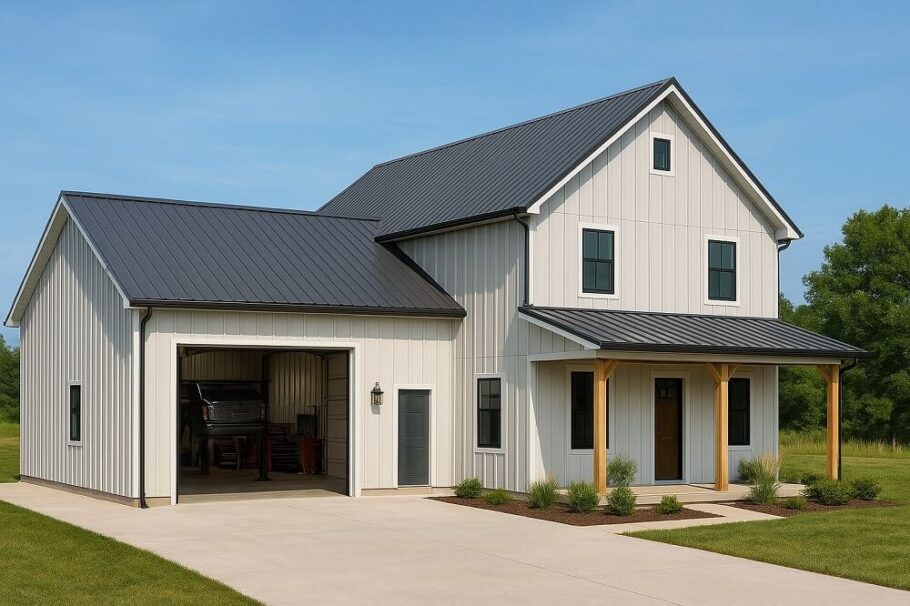
The barndominium craze shows no signs of slowing down. And for good reason—these steel-framed hybrids offer open floor plans, lower construction costs per square foot, and the chance to live right next to a workshop or garage. But here’s the thing no one puts in the glossy Instagram photos: plenty of barndominium owners end up regretting key design choices. Some mistakes cost thousands to fix later. Others turn a dream home into a daily frustration.
The good news? Those mistakes are entirely avoidable. Real builders and owners have learned the hard way, and their lessons are worth paying attention to. Below are the most common barndominium design pitfalls, pulled straight from actual build experiences.
Underestimating Insulation and Thermal Bridging
Metal conducts heat and cold like a highway. That’s not an opinion—it’s physics. Yet countless barndominium plans treat insulation as an afterthought, or worse, rely solely on fiberglass batts stuffed between steel girts. The result? Freezing bedrooms in winter, sweltering lofts in summer, and utility bills that rival a traditional house twice the size.
Real builds show that spray foam insulation—closed cell on the roof deck and open cell on walls—performs dramatically better than batts. But even foam won’t fix thermal bridging, where heat escapes through the steel framing itself. Some owners have torn out drywall to add rigid foam boards over the girts before finishing. That’s an expensive retrofit. The smarter move is designing thermal breaks from the start, using hat channels or adding exterior insulation before the metal siding goes on.
One build in Texas learned this the hard way. The owner skipped spray foam to save money, went with R-19 batts, and watched condensation drip down interior walls every winter morning. By year two, rust had started forming on screw heads. Moral of the story: never skimp on insulation in a barndominium. The metal shell demands overkill.
Ignoring Condensation and Moisture Control
Speaking of condensation—this one deserves its own spotlight. Barndominiums trap moisture differently than wood-framed houses. Warm, humid interior air hits cold metal surfaces, and water appears. Without a proper vapor barrier and ventilation strategy, that moisture leads to mold, mildew, and corrosion.
Several real builds have reported musty odors within six months of moving in. The culprit? No vapor barrier under the slab, combined with unsealed concrete floors. Moisture wicks up from the ground, gets trapped by vinyl plank flooring, and festers. The fix involves ripping up floors, installing a proper vapor barrier, and sometimes adding a dehumidifier system.
Another common mistake: sealing the building too tight without mechanical ventilation. Barndominiums can become airtight—especially with spray foam—but without an energy recovery ventilator (ERV) or heat recovery ventilator (HRV), indoor air quality tanks. Stale air, cooking odors, and off-gassing from adhesives have nowhere to go. Builders who skipped ERVs now crack windows in freezing weather just to breathe fresh air. Don’t be that owner.
Poor Window Placement and Sizing
A barndominium without enough windows feels like an aircraft hangar with furniture. But slapping in a few standard windows won’t cut it. Real builds reveal two opposite mistakes: too few windows, or windows placed without regard for sun angles and prevailing winds.
The “too few” problem often comes from budget cutting. Windows are expensive, and barndominium walls are big. Some owners put windows only on one side, leaving the rest of the living space dark and cave-like. The solution isn’t necessarily more windows—it’s smarter placement. Group windows on south-facing walls for passive solar gain. Add high clerestory windows for natural light without sacrificing wall space for cabinets or shelving.
On the flip side, some builds go wild with floor-to-ceiling glass without considering heat gain. A barndominium in Oklahoma with massive west-facing windows turned into a greenhouse every afternoon. The owners installed exterior shades and tinted film, but the damage to their cooling bills was already done. Lesson learned: window placement matters more than window count. Run a simple sun-angle calculation before finalizing the design.
Messing Up the Slab and Foundation
Here’s a mistake that gets buried—literally—under concrete. Barndominiums typically use monolithic slabs or post-tension slabs. But not all slabs are created equal. Real builds have cracked, settled, and heaved because of three common errors: insufficient rebar, no control joints, or pouring on poorly compacted fill.
One build in Colorado poured a beautiful 6-inch slab with fibermesh reinforcement but forgot control joints. Within a year, a hairline crack ran from the kitchen island to the exterior wall. It wasn’t structural, but it was ugly and collected dirt. The owner ended up covering it with an expensive epoxy coating just to hide the crack.
More serious is the issue of slab thickness under heavy equipment. Barndominiums with attached shops need thicker concrete—sometimes 8 to 10 inches—where a truck or tractor will park. Owners who poured a uniform 4-inch slab across the entire building later regretted it when their pickup left divots. Plan for zones: living areas get standard thickness, shop and garage zones get reinforced thicker sections.
And don’t forget to embed plumbing sleeves and electrical conduits before pouring. Sounds obvious, but multiple builds have had to jackhammer through finished slabs to add a toilet drain or floor outlet. That’s a messy, expensive fix that could have been solved with an afternoon of layout planning.
Overlooking Electrical and Lighting Needs
Barndominiums have long spans and high ceilings—great for open layouts, terrible for lighting if not planned right. A single ceiling fan in the center of a 40-foot great room leaves corners in darkness. Real builds show that owners consistently underestimate how many light fixtures they need.
The fix is layering: ambient overhead lighting (recessed cans or linear LEDs), task lighting over kitchen islands and workbenches, and accent lighting for artwork or architectural features. And put them on dimmers. Barndominium owners who skipped dimmers now squint at night or blast themselves awake at 6 AM.
Electrical outlet placement is another pain point. With steel framing, adding outlets later means surface-mounted conduit—which looks industrial in a bad way. Plan for outlets every 6 to 8 feet along walls, plus extras in the shop at workbench height. Don’t forget floor outlets in large open areas where furniture might float away from walls. One owner had to run extension cords across their living room for two years because they only put outlets on the perimeter. That’s not rustic charm; that’s a tripping hazard.
Ignoring Soundproofing Between Spaces
Here’s a mistake that ruins relationships. Many barndominiums combine living quarters with a shop, garage, or home business space. Without proper soundproofing, the whole house hears every air compressor kick on, every table saw rip cut, and every garage door opener.
Real builds have tried everything: extra drywall, resilient channels, even egg-crate foam. What actually works? A dedicated double wall assembly between shop and living areas—two separate sets of studs with an air gap, plus insulation in both cavities. Mass-loaded vinyl also helps, as does using different drywall thicknesses on each side (5/8-inch on one side, 1/2-inch on the other) to change the resonant frequency.
One owner built a beautiful barndominium with a metalworking shop just behind the master bedroom wall. No soundproofing. The first time they fired up a grinder at 9 PM, their partner threatened to move into the chicken coop. They eventually built a separate interior wall, but it cost $4,000 and shrank their living space. Plan for noise from day one.
Bad Interior Layout and Wasted Space
Open floor plans are a barndominium hallmark, but open doesn’t mean functional. Real builds reveal layouts that look great empty and become frustrating once furniture and daily life move in. Common problems: kitchen islands that block traffic flow, bedrooms with no closet space because no one thought about how steel framing affects wall depth, and lofts that are too hot or too cold to actually use.
The loft issue deserves special attention. Barndominiums often have tall walls perfect for a second-story loft. But lofts inherit the roof’s temperature swings. Without dedicated HVAC or at least a mini-split, those lofts become unusable for half the year. Multiple owners have converted their dream loft spaces into storage because summer heat made them unbearable.
Another layout mistake: putting the utility room on the opposite end of the house from the bedrooms. Carrying laundry baskets across a 60-foot barndominium gets old fast. Same with placing the pantry far from the kitchen or the mudroom nowhere near the most-used entry. Walk through your floor plan on paper—better yet, tape it out on a parking lot—before committing.
Skimping on Storage and Future-Proofing
Barndominiums look spacious until every horizontal surface is covered in clutter. Real builds consistently underestimate storage needs. Where are the brooms, the vacuum, the holiday decorations, the camping gear? In a traditional house, closets and basements solve this. In a barndominium, owners often forget to design storage at all.
The smart ones build a walk-in storage room off the mudroom or garage. Others add floor-to-ceiling cabinets in the utility room. The ones who didn’t? They end up with storage sheds outside, which defeats the whole purpose of having a barndominium.
Future-proofing is another overlooked area. Will aging parents move in someday? Add a ground-floor bedroom and bathroom now, even if you use it as an office. Thinking of adding solar panels? Run conduit from the roof to the electrical panel during construction. Want a hot tub later? Pour a thickened slab section and run 240-volt wiring now. These additions cost very little during initial build and a fortune as retrofits.
Choosing the Wrong Flooring
Concrete slabs are great for thermal mass and durability. But bare concrete is hard on joints, cold on bare feet, and unforgiving when you drop a plate. Many barndominium owners pick flooring based on looks alone, ignoring how it performs over a slab.
Polished concrete looks amazing but shows every dust bunny and water drop. Stained concrete can fade unevenly near windows. Vinyl plank floats over the slab and feels warmer, but cheap vinyl telegraphs every slab imperfection. Tile is durable but freezing in winter without radiant heat.
The builds that work best use layered flooring: radiant heat tubes in the slab (even if not hooked up initially), then a vapor barrier, then a floating floor with an attached pad. Owners who skipped radiant heat regret it every January. Those who installed it love walking barefoot in December.
Real tile or stone over a slab requires an uncoupling membrane like Schluter Ditra—multiple builds learned this after grout lines cracked within months. Don’t skip it.
Forgetting Exterior Details
The barndominium exterior gets plenty of attention—metal siding, trim colors, cupolas. But practical exterior mistakes are everywhere. Downspouts that dump water next to the foundation. No overhangs or gutters at all. Doors that face the prevailing winter wind. Landscaping that traps moisture against the metal walls.
One build in the Pacific Northwest skipped gutters entirely because the owner thought the metal roof would shed water far enough. Within a year, rain had eroded a trench around the foundation and splashed mud onto the siding constantly. Gutters went up—at twice the normal cost because of the tall walls and tricky access.
Another common regret: not adding a covered porch or deck. Barndominiums can feel boxy and exposed without some kind of transition space between indoors and outdoors. A simple 8-foot-deep porch along the living area provides shade, rain protection, and a place to sit outside without feeling like you’re in a field. Builds without them always add them later.
The Bottom Line
Barndominiums are fantastic homes, but they aren’t forgiving of design shortcuts. Every mistake listed here comes from real builds where someone said “we’ll figure it out later” or “that won’t matter.” It matters. Insulation matters. Moisture control matters. Window placement, slab thickness, soundproofing, storage—all of it matters more in a metal building than in a stick-framed house.
The best advice from owners who’ve been through it? Spend your money on the things you can’t change later: foundation, insulation, windows, electrical rough-ins, and soundproofing. Save money on finishes that can be upgraded over time—paint, light fixtures, cabinet hardware. And walk through your floor plan with a critical eye before breaking ground. Future you will thank present you for avoiding these mistakes.